Question: Does Cloudpost mana for more changeling-cards because, in theory, they too Locus. Sticking to what I do not know, Locus is only land type (such as Swamp), or it may be creature type too?
Thanks in advance.
Answer: Locus is only land type. Creature types and Land Types are different things. Also there is no "Locus" creature type in creature types list.
Question: I apologize for asking this question if it has been answered before, but does a changeling creature also have the creature type of a wall? If so it would not be able to attack correct?
Thanks
Answer: It has every creature type, including wall. However, no creature types have any rules baggage on them anymore, so just having the creature type wall will not prevent it from attacking. Most walls have been errataed so they have the ability defender now, which works the same way.
Question: Does Coat of Arms work with the creatures Chengeling? I mean, whether they +1 / +1 for each of its type? They have all the same types of creatures.
Thanks
Answer: Coat of Arms
Free translation:
"Coat of Arms". Each creature gets +1 / +1 for each other creature in the game with its generic type of substance.
Does Coat of Arms work with the creatures Chengeling?
1. Effects of Coat of Arms extends to every creature.
2. Creatures with Changeling are creatures.
3. Consequently, the Coat of Arms and operates creatures with Changeling.
Answer: Yes, the works.
whether they +1 / +1 for each of its type?
Ability of Coat of Arms says nothing about "for every type of creature".
Answer: No, not receiving.
PS Like any other creature, a creature with Changeling get +1 / +1 for each other creature in the game with its generic type of substance. The number of overlapping types of creatures does not matter.
Question: Explain, please, can I get a creature with Changeling from deck with ability of Amrou Scout? Or rebel is not a Creature type?
Answer: All rebels card have errata about searching "REBEL CARDS". Now they have search "REBEL PERMANENT CARD". It means that Amrou Scout can search permanent card with changeling.
To be continued...
Thursday, December 13, 2007
Some Changeling Questions
Layers in Magic The Gathering. Rules.
This article is designed to describe and explain Rule 418.5 of the Comprehensive Rulebook, highlighting the changes that occurred with the Ravnica update. This rule and it's subrules cover the interaction of continuous effects, which is one of the most complicated concepts in the game. I hope this article will make it easier for players and judges to understand it. Next week, I'll follow up with examples [And charts. Lots of charts. -Seamus] to illustrate the rules at work.
The continuous effect is governed by four concepts, which are applied in priority order:
1. Layers
2. Dependency
3. Characteristic-Setting Abilities before others
4. Timestamp
What I mean by "priority order", is that each of these four concepts tell you a way of ordering or grouping effects. What I'm saying is which ones trump which. For example, dependency trumps whether or not an ability is a characteristic-setting ability and timestamp, but layers trump dependency.
I'll explain each of these four concepts, how to tell order effects based upon them, and finally end with some situational examples. So, let's get started
Layers
There are six layers, with the last layer having five sublayers. These layers sort the effects by what kind of effect they are. In other words, they're sorted by categories of what they do. The layers, in order from earliest applied to last applied, are:
Copy—Copy effects go here. Examples: Clone, Dimir Doppelganger
Control—Things that change an objects's controller go here. Examples: Control Magic, Vedalken Shackles
Text—Things that alter an object's text. Examples: Artificial Evolution, Mind Bend. [Note that this only refers to altering text, not adding or removing text. Humility doesn't fit in here. -Seamus]
Type—Things that change an object's type, subtype, or supertype. Examples: Opalescence, Mycosynth Lattice (1st ability), Sensei Golden-Tail, Blinkmoth Nexus.
Other—Anything that's not earlier in the list and doesn't alter power/toughness goes here, such as changing an object's color, or removing or granting it abilities. Examples: Shifting Sky, Humility, Mycosynth Lattice (2nd ability), Crimson Kobold, Kavu Runner.
P/T—Anything that alters power and toughness. This layer has five "sublayers". There is no rules discintion between the functionality of these as layers vs. sublayers, it's just clearer to understand with all the power/toughness effects grouped together in some way.
The sublayers for layer 6 are:
(6a) P/T CSAs—More on what a CSA (Characteristic Setting Ability) is in a minute (see 6c below). Examples: Maro, Nightmare.
(6b) P/T: Changes from resolving spells, triggered abilities, or activated abilities and changes from static abilities that set the P/T to specific number—Note this includes all P/T effects from things that resolve, regardless of what it does to the actual P/T. The "setting only" clause just applies to static abilities Examples: Giant Growth, Basking Rootwalla, Humility.
(6c) P/T: Changes from counters—Nothing too special here. That +1/+1 counter that's sitting on your Arcbound Ravager? Apply the +1/+1 here.
(6d) P/T: Changes from static abilities that adjust the power/toughness by increasing or decreasing them by a certain amount, not setting them to a number—Note the contrast here against 6b. Examples: Bonesplitter, Castle.
(6e) P/T: Switching—Apply switching of power and toughness here. Examples: Aquamoeba, Strange Inversion.
Splitting layers for fun and profit
As you'll notice, some effects apply in multiple layers. I cited Humility above as being in both 5 and 6b, for example. These are handled by splitting the effect up so each part applies in the appropriate layer. The "remove all abilities" part of Humility's effect applies in its layer (layer 5), and the "are 1/1" part applies in its layer (layer 6b).
Also note that an effect "locks in" what it does and what objects it applies to the first time any part of it is applied. So even if the effect generated by Humility removes the ability (because an Opalescence is in play, making Humility a creature), the p/t altering part will still apply.
(Reversal Note: It used to be that if some part of effect applied in the type layer (layer 4), and the rest applied elsewhere, that you'd apply the entire effect in that layer, without splitting it up. This is no longer the case. Also, the part about "locking in" the effect the first time part of it applies is a new concept that was previously not true.)
Dependency
If you read the rulebook, the first think you learn about dependency is that two effects in different layers cannot depend on each other. This is true, but if you follow the Layer-Dependency-CSA-Timestamp model, whether or not it is true becomes irrelevant, so I won't bother getting into it further.
Beyond that, you can determine dependency as follows: Effect A is dependent on Effect B if applying Effect B before Effect A would do any of the following:
change the text or the existence of Effect A
change what objects or players Effect A will affect
change what Effect A does to any of the things it applies to
For example, if something gives all creatures a given certain subtype, like Goblin, it depends on an effect that changes all lands to creatures, as changing the order they're applied in will change if the land-creatures become Goblins or not. Hopefully, this concept is fairly intuitive. [Don't confuse 'intuitive' with 'straightforward'—I've watched a cadre of Rules Managers, Level 3 and 4 judges, and Magic Online programmers bicker about whether two effects were dependant or not. -S]
How does this help define the order? The answer is simple. An effect dependent on one or more other effects can't apply until all of those effects have applied already (and it waits to do so). This means those land-creatures will end up being Goblins, in our example.
Note: It is possible for there to be a dependency loop, where Effect A and Effect B both depend on each other, for example. If this occurs, just ignore dependency entirely for those effects.
Characteristic-Setting Abilities (CSAs)
Looking at the glossary, a Characteristic-Setting Ability as an intrinsic ability that states the object the ability is on either:
"has" one or more characteristics
"is" a particular type, supertype, subtype, or color
has characteristics that "is" or "are" certain values
There's really not a better way than this to determine what a CSA is. Fortunately, it's easier to think about why we care about CSAs at all.
The idea is that they are abilities that define characteristics (power, toughness, color, etc.) that can't practically be on the card. Color is normally defined by mana cost, so Evermind (a card without a mana cost) cannot have a color, unless it is defined explicitly another way: by saying "Evermind is blue." on the card. Maro is similar, as it reads "Maro has power and toughness equal to the number of cards in your hand." There's no way to print this in the power/toughness box of the card, so an ability provides this instead.
Effects from CSAs apply before those that aren't from non-CSAs, unless (remember the precedence order) the layers or dependency indicate otherwise.
(Reversal Note: CSAs used to be applied before non-CSAs, even if a CSA was dependent on a non-CSA. This is no longer the case.)
(Reversal Note: In the past, a CSA could be granted on to an object, instead of having it intrinsically, and it would still be considered a CSA. This is no longer the case.)
Timestamp
Finally, we get to timestamp. The timestamp of an ability is, in general "when its effect began". Explicitly:
Spells, activated abilities, and triggered abilities have the timestamp from when they resolved.
Static abilities that are granted onto an object have the timestamp of when the ability is granted.
Static abilities that are on the object itself have the timestamps of when the object entered the zone that it is in.
Finally, an object that becomes attached to another object, and any abilities on the object being attached, get their timestamps reset to the time when the attach occurs. Note this actually only occurs if it wasn't attached before; attaching an object to an object it was already attached to doesn't get its timestamp reset.
Finally, it's possible that objects would get the timestamp by coming into play simultaneously due to an effect such as Replenish. If this occurs, the active player at the time chooses a relative timestamp order. Note that this does not change the fact that they come into play simultaneously; it just provides an order for continuous effect evaluation. Any triggered abilities will still see them all come into play simultaneously. This order is chosen at that time, and cannot be changed later.
So how does timestamp effect ordering? Simple. The earlier the timestamp, the earlier it applies. And, since timestamp (with the "active player" tiebreaker) provides a definitive order for all effects, then the order is never ambiguous.
Is all this really necessary?
Why all these layers? Why are they in this order? Is this just some random arbitrary order? No, it's not at all random. These came about by looking at all the cards and looking at the "natural dependencies". Control changing stuff needs to happen early, because a lot of effects depend on who controls a permanent. A lot of random effects depend on the type, supertype, and subtype effect of an object. Finally, no continuous effect modifier cares about the power/toughness of a creature, so those are last, and so forth.
Additionally, R&D spent time coming up with the "right answers" to the questions, and the rules were written such that the result of applying the rules was these "right answers". So are the "right answers" arbitrary, then? In a manner of speaking, yes. But a lot things are designed so they line up with the way it is believed most players who didn't know or didn't have access to the rule would assume it would work, and these layers (especially the Ravnica changes) attempt to accomplish just that.
That's it for now. We'll return shortly with examples to show these concepts at work. Thanks for reading!
-- Lee Sharpe, lee DOT sharpe AT gmail DOT com DCI Level 3 Judge
Wednesday, November 21, 2007
Shortcuts – Understand the philosophy of PG section 51
There's bound to be questions about the new Shortcut Guidelines. We had more than our share of questions while writing this section; certainly, you're expected to have a few of your own. The conclusions from our debates are reflected in the result, but that may not be apparent to judges and players everywhere. This article will attempt to address that, presenting a detailed analysis of Section 51.
Before we dive in, there's one basic, underlying concept we need to emphasize. This new section does not mean we need to closely monitor the correctness of everything the players say and do. This new section provides a guideline for handling misunderstandings. As long as the players are communicating clearly, we don't need this section; when a dispute about shortcuts occur, this section will help judges unravel the tangles and get the game back on track.
Alrighty then – on to the second new section in the Penalty Guide...
51. Shortcuts
The first question comes up before we even get into the first paragraph. Namely, "what is this section doing in the Penalty Guidelines?", or "Doesn't it belong in the Floor Rules or somewhere?" Yeah, it probably does. The thing is, we been workin' on the PG, all the live-long year. We'll give the UTR and MFR a good workover, too – but not soon enough for stuff this good.
A shortcut is an action taken by players to skip parts of the technical play sequence without explicitly announcing them. Shortcuts are essential for the smooth play of a game, as they allow players to play in a clear fashion without getting bogged down in the minutia of the rules.
Well, nothing too new or exotic here. We all use shortcuts, and have since we first learned to play games. You couldn't enjoy most games without them – much less complete a match within 50 or 60 minutes.
Most shortcuts involve skipping one or more priority passes to the mutual understanding of all players; if a player wishes to demonstrate or use a new shortcut entailing any number of priority passes, they must be clear where the game state will end up as part of the request.
And BOOM just like that, we hit you with a big one. There's a lot of foundation in that sentence; let's look a little closer.
One or more priority passes – yep, shortcuts skip ahead, even way ahead. Untap, Draw, play a land, say "Go" – you just skipped something like 13.71 priority passes. (The exact number is known only to a few "special" people, all of whom are locked up in Gleemax's secret chamber deep beneath Wizards' offices.)
mutual understanding of all players – well, we probably all know that shortcuts aren't much good if players all think they're in a different phase or step after the dust settles. Two things implicit here: first, all players agree to the implementation of the shortcut; second, all players agree where the shortcut will take them.
demonstrate or use a new shortcut . . . where the game state will end up. This is really stating that you can't just make up shortcuts without clueing in your opponent(s). That should be obvious – but obvious doesn't preclude clear statement in the rules.
Oh, and – any number of priority passes – we're just reinforcing the concept that shortcuts can be simple or complex, in terms of how much is skipped – but we're going to treat them equally.
Wow – one paragraph done already! See how easy this is gonna be?
A player may interrupt a shortcut by explaining how they are deviating from it or at which point in the middle they wish to take an action.
This is really simple. Once you've established a shortcut, you stick with it – until you don't. And when you don't, you just have to say so.
If the players are confused by the use of a shortcut, they should be backed up to the beginning of the shortcut and no penalty should be issued (though they should be reminded to play more clearly).
That's a simple, direct guideline for handling a common misunderstanding. There may be cases where either player – or both – gives away more strategic info than they'd like. That's unfortunate – but it's not a reason to deviate from this. That happens when players charge ahead recklessly, each of them thinking they know what the other is thinking – and both are mistaken.
Avul Hurry: "Attack you with my Grizzly Bears, and your Planeswalker with my Hill Giant."
Rod Rushit: "Sure . . ."
Avul: "OK, so you've got no one that can block, I'll Giant Growth my dude, you take 5?"
Rod: "Whoa there cowboy, I'm playing this here Foriysian Interceptor and blocking both!"
Avul: "What? Wait! JUDGE! ... He said 'sure'"
Rod: "I said 'sure' to your attacks, dude . . ."
Joe Judgerson: "Well, we back up a bit; Avul's declared attackers, since that's where you got confused; Avul, you have priority."
(players in unison, if not perfect harmony)
Avul: "But now he knows I've got a Giant Growth!"
Rod: "But now he knows I've got Foriysian Interceptor!"
Joe Judgerson: "You both need to be clear in the future."
ote that the judge didn't assess any penalty, he just determined where the players got out of sync with a shortcut, and rewound to that point. This wouldn't apply if the game progresses beyond the shortcut, as that implies the players accepted the result of the shortcut. Note also that the players didn't represent anything as a shortcut – they may not even recognize it as such. That often happens with miscommunication – one player proposes a shortcut by virtue of skipping ahead, explicitly or implicitly; the other player can agree, disagree, or be confused. It's the judge who recognizes it as a shortcut, applies the wisdom from Section 51, and makes everything all better again.
Essentially, that covers a lot of the confusing attempts to mess with the timeline of a game. And this next sentence wraps that up nicely.
A player is not allowed to use a previously undeclared shortcut, or to modify an in-use shortcut without announcing the modification, in order to create ambiguity in the game.
Until you establish a shortcut, there is no shortcut. And again, once you establish a shortcut, you stick with it – until you say otherwise. But even more important: in order to create ambiguity in the game – that's the key concept in our first "Thou shalt not!" Players use many bluffs to try and gain advantage. We acknowledge that's part of the game, and Section 50 of the PG addresses many of the boundaries.
What we're trying to say here is that players should not mess with shortcuts to confuse their opponents (nor themselves, for that matter).
Now, what to do with such a player? Apply the new penalty from the new Guide? Well, there isn't one. We added a new penalty because of Section 50:
137. Tournament Error – Player Communication Violation
and the definition of that new penalty includes:
A player unintentionally violates the Player Communication guidelines (see section 50).
No mention in there at all of section 51 and these Shortcuts. A further search of the whole Penalty Guide doesn't refer to Shortcuts. So what is the penalty for violating this?
Let me repeat: there is none. It's enough to explain to the player that their intent to create ambiguity via shortcut shenanigans is unacceptable – and to refrain from doing so again. (If they continue to ignore that last instruction, then you may have an instance of Unsporting Conduct.)
A player may not request priority and take no action with it. If they decide they do not wish to do anything, the request is nullified and priority is returned to the player that originally had it.
Very simply, this solves that rather nasty stolen priority trick. A classic example of this very "cheesy" trick:
Ned Naive: "Done with combat, so in my second main . . ."
Carp Cheeserman: "Hey, can I 'Bolt' you now?"
Ned Naive: "Uhh . . . sure?"
Carp: "OK, you passed priority to me, I'll pass too – guess it's your end of turn!"
Yeah . . . that just ain't right. We all know that isn't right; now it's in writing. We remain in Ned's second main phase, Ned has priority, and Carp has been told that his intent to create ambiguity via shortcut shenanigans . . . oh, wait, we've covered this, haven't we?
Certain conventional shortcuts used in Magic are detailed below. If a player wishes to deviate from these, they should be explicit about doing so. Note that some of these are exceptions to the policy above in that they do cause non-explicit priority passes.
Again, we aren't trying to detail the exact shortcuts players must use; we're just establishing the precedent for some already common shortcuts, and detailing a few that are infamous for the trouble they've caused. This isn't an exhaustive list, but it is the list that we are comfortable with as pre-established, common to players everywhere, and safe for assumption.
The statement "Go" (and equivalents such as "Your turn" and "Done") moves the turn to that player's end step and passes priority to the non-active player. Opponents are assumed to be taking actions at that point unless they specify otherwise.
Someone suggested – even requested – examples. Sounds like a great idea:
Eddie Everyplayer: "Untap ... draw ... play a land ... go"
That's one of the most common turns in Magic – and probably the most common shortcut, too. Sure, there's colloquial variations on 'go' (I've been called "goat head" by any number of mumbling opponents), language differences, physical gestures that may be more common in some play groups – but it's the same, simple concept.
So, what's a common example of deviating from that shortcut? How about that Onslaught block staple, Astral Slide?
Eddie's opponent, Sid Sliderman: "Wait, Eddie. During your second main, I'll cycle this and Slide that out . . . are you still done? OK, it comes back and, unless you've got anything in your end step, it's my turn?"
A statement such as "I'm ready for combat" or "Declare attackers?" moves the turn into the Beginning of Combat Step and passes priority to the non-active player. They are assumed to be acting then unless they specify otherwise.
This is also one of the most common shortcuts in use, and one of the first to get "official recognition". Let's consider a counter-example, illustrating how players tried to abuse this:
Sham Shady: "Combat?"
Ned Naive: "Let's tap that Hill Giant first."
Sham: "OK, we're still in my first main phase, then, so I'll play Ball Lightning, then I'll attack! Muahahahaha!!!"
Ned: "uhhh . . . Judge? Can he do that???"
Well, not any more. That's been true for at least a few years.
Whenever a player adds an object to the stack, they are assumed to be passing priority unless they explicitly announce that they intend to retain it. If they add a group of objects to the stack without explicitly retaining priority and a player wishes to take an action at a point in the middle, the actions should be reversed up to that point.
This has caused a lot of well-scratched heads, looks of perplexed puzzlement, constant consternation . . .
But really, this is how players play the game. In the Comprehensive Rules, 408.1c tells us that when a player "plays a spell or ability, or takes a special action, the player again receives priority". Like many (most? all?) shortcuts, this one contradicts the rules – but does so in a way that is universally understood.
It's actually the exception that a player plays a spell or ability, and wants to respond while they have priority. Usually, when something is played, priority is passed implicitly – usually with nothing more significant than a pause, a look at the opponent, or a hand gesture. If anything, this shortcut is more important for what it doesn't allow – namely, hesitating after you play something, fishing for a reaction from your opponent, and then claiming to have kept priority and act with the knowledge of your opponent's reaction.
"No attacks" or similar statements during combat are an indication that the active player has passed priority in the end of combat step.
This usually comes about like this:
Abe Average: "Combat?"
Alice Average: "Uhhh, tap that big bugger first . . ."
Abe: "Yeah, yeah . . . no attack, then."
Abe is in his second main phase, unless Alice has reason to interrupt the shortcut. This shortcut isn't that much of a stretch; consider 308.4: If no creatures are declared as attackers, finish the declare attackers step, but skip the declare blockers and combat damage steps. All we're adding to that is the implied pass during the end of combat step.
If a player announces an X spell without specifying the value of X, it is assumed to be for all mana currently available in their pool.
Inspired in part by a recent judge discussion, this is less about the way everyone plays, and more about the way we want the game played.
Sham Shady (has 10 lands untapped): "Tappity-tap-tap-it-all . . . Fireball for the win!"
Dave Decent (who's at 6 life): "I'll Mana Leak that."
Sham: "Sure, I'll use 3 of my mana for the Leak, Fireball resolves for 6, you lose!"
Very few judges would allow that – ideally, no one would – but now it's clearly stated.
A strict interpretation of 409.1b tells us that the value of X has to be announced – but if a player shortcuts past that, X defaults to whatever mana they had in their pool.
Players are assumed to have paid any cost of 0 unless they announce otherwise.
Another shortcut inspired by recent discussions, and frequent questions about Thick-Skinned Goblin ("You may pay 0 rather than pay the echo cost for permanents you control."). A player who doesn't clearly state she's paying 0 as the echo cost for something is assumed to have paid that echo cost.
As you might imagine, this required a bit of discussion; we reached this conclusion primarily because it's what most players would expect, and what is most likely to have happened. If a player has reason to not pay an Echo or Cumulative Upkeep cost of 0, they're going to announce that clearly, just because it is so unusual.
A player is assumed to have assigned all trample damage possible to the defending player unless stated otherwise.
For trample, it's been observed – over a dozen years or so of experience – players will assign lethal damage to the blocker(s), and the rest to the player. Like the other shortcuts, we're just recognizing what's already established.
This occurs most commonly like this:
Ozzy Obvious: "Attack with Giant Warthog." (5/5 Trample)
Abe Average: "Block with my Grizzly Bear."
Ozzy: "Damage on the stack?"
Abe: "Sure, then I'll Giant Growth my Bear so it survives . . . I take 3?
At this point, Ozzy would probably like to claim that he assigned all 5 to the Bear, but he didn't say that, so he can't.
Wait, wait – what about Rhox, or Thorn Elemental (You may deal its combat damage to defending player as though it weren't blocked)? Would we default to assigning all the damage to the defending player? We can't establish such a precedent for Rhox or Thorn Elemental; it's not nearly as common an effect as is trample, and you may need to kill the blocker more than you need to damage the defending player. That example just needs clear communication, period.
A spell or ability that targets an object on the stack is assumed by default to target the legal target closest to the top of the stack.
Remand: (Counter target spell. If that spell is countered this way, put it into its owner's hand instead of into that player's graveyard.)
Need we say more? Yes? OK, OK. . . consider this exchange:
Bolt you.
Counterspell.
Rewind!
Pact in response.
Remand?
Remand!
Yeah, it gets that messy, sometimes – and it might be important to know if that Pact was countered, or if the Remand that followed it targeted the original Counter, or something else and will either player's spell go back to their hand, will the Rewind untap any lands, etc. Now, applying this shortcut, we get the following defaults from that exchange:
Bolt you.
Counterspell. (the Bolt)
Rewind! (the Counterspell)
Pact in response. (the Rewind)
Remand? (Pact)
Remand! (Remand)
The head to which damage is being assigned in Two-Headed Giant is undefined by default. If it is relevant, it is up to the team that knows it may be relevant to ask for clarification or to propose an alternate shortcut.
This is interesting – it's not a shortcut. Quite the opposite – this is clearly stating that there is not an established shortcut for this. More than anything, we want players to establish this themselves at the earliest opportunity.
Tom Thoughtful: "Hey, guys, good luck this match! Oh, by the way – when we deal damage, it'll be to your primary head if we don't say otherwise."
Carl Catchezon: "Uhh, yeah ... same here."
Unfortunately, what usually happens is more like this:
Team Forgetful: "Attack with these seven guys, you can't block . . . we win?"
Team LastHope, A player: "I'll morph up our Weathered Bodyguards, he'll take all the damage."
Now, Forgetful hasn't specified where the damage is being assigned, and LastHope is assuming it's to their A head. Unfortunately, that's not the default, and instead we have to back up (to the beginning of the confusing shortcut) and have Forgetful clearly state where the damage is assigned.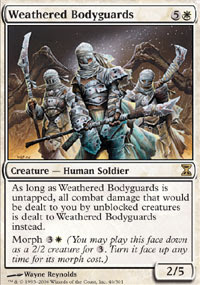
Neatly enough, that harkens back to one of our first examples, where the players will object with "But now they know about the Bodyguards!" Just like in a previous example, they failed to be clear, and now additional information is available – unfortunate, yes, but neither significant nor exceptional.
One more interesting point, somewhat illustrated by this last topic, and somewhat implicit from everything else we've said – shortcuts that aren't clearly stated in here should be established in some manner before they're used.
The list of shortcuts is not exhaustive. It is not intended to be, nor become, exhaustive. It is intended to provide clear examples of the philosophy we want our judges to use as their guide, when you encounter unusual situations that don't match any of the listed shortcuts.
Well, we certainly hope you've enjoyed this rambling run through the Shortcuts. More than that, we hope that it makes a lot more sense now than before. And if not, then your questions become our top priority!
www.wizards.com
