I've seen it happen, and it's not a pretty sight. A player goes to a PTQ full of hopes and dreams but picks up a crucial game loss or even a disqualification for an innocent mistake and his dreams of Top 8 are dashed. Even worse, he's been accused of cheating, and that's not something anyone wants to be known for. It's a horrible feeling and it leaves a bad taste in everyone's mouths.
The good thing is that all of this can be avoided by taking some precautions. These horror stories make some people treat a PTQ like a Big Scary Thing™, but it's really not. With some care and attention to detail, it's a lot like any other tournament, but with a bigger prize at the end. With these precautions, you can avoid unnecessary warnings, game losses, and disqualifications.
Before the tournament starts
Deck registration
This is simply a matter of paying attention to detail. Even if you don't have all the cards and you need to trade for them the morning of the event, you should have a decklist brought to the tournament, which you can copy onto your registration sheet. When you're scrambling for cards, things can get really hectic and it's really easy to miss that four-of, resulting in a fifty-six-card decklist.
If you are going to play with foil cards, be sure you have a mix of foils throughout your deck. If the only copies of Korlash you can find are the prerelease ones, be sure to have some random foil lands and other foil cards in your deck. At a PTQ, someone had four DCI foil Psychatogs in his deck because he couldn't find regular ones. Psychatog was obviously a key card in the deck, so when the judges found they could consistently cut to the Psychatog in his deck, he got a disqualification without prize. This was a player whose reputation was (and still is) sterling and someone who is known for his rock-solid integrity and honesty, but the judges still gave him the DQ on principle. Don't make that mistake.
Foils are cool and all, but I'm absolutely paranoid about playing them and I don't like to do it. I strongly recommend leaving the foils for your FNMs or trade binder and play with non-foil cards.
For Limited play, pay extra attention to detail and don't just blow through the decklist if there's a deck swap. I had a situation at a PTQ where the pool I received had a foil Plains and the registering player marked the Plains in the “played” box. I alerted a judge immediately, and he signed off on the change. Later in the tournament I got deck checked and a different judge called me over to give what was about to be a game loss for misregistering my deck. But since I consulted with a judge earlier on this issue, I was able to explain what had happened, that the Plains wasn't supposed to be in my deck, and judge so-and-so okayed the deck registration error.
On the deck registration sheets, write clearly. If you make a mistake and need to cross it out, cross it out and write on a different line. Don't try to write over the previous thing, as it tends to get muddy and it increases the likelihood of a judge misreading it.
Use new sleeves
In Constructed tournaments, make sure your sleeves are new and of a good brand with no reflective backs, no patterns on the back (the Magic branded one excepted), and no reflective faces. They should be a brand that doesn't mark easily. If you aren't sure if the sleeves are okay, check with a judge.
When you sleeve your deck, make sure it's been shuffled beforehand. If there's a factory defect with some of the sleeves and you happen to have all of your land in these slightly marked sleeves, it could create issues down the road if you get deck checked. To a judge, all they see is a pattern of marked cards that correspond to land. That doesn't look good for you. Having your cards randomized before they go into the sleeves will avoid this situation.
Pile shuffle your deck and look at the backs carefully for any markings or defects. I also suggest sleeving only your main deck and leaving the sideboard card unsleeved. Over the course of a long tournament, your main deck sleeves will be more worn than your sideboard sleeves and it could be considered marked. Though be sure to keep extra sleeves on hand in case one breaks. I've seen someone make the mistake of bringing exactly sixty cards to a tournament, and when one broke, he didn't have a replacement.
For Limited events, I suggest using sleeves as well and giving your deck the same treatment. An added benefit of sleeving is that over the course of a long tournament, your unsleeved cards will clump up and your nonland cards tend to stick together, contributing to mana issues in the later rounds. I know a guy who will aggressively shuffle his opponent's unsleeved decks in later rounds for this very reason.
Before the match
Show up on time
This should be an easy one, but it's important nonetheless. If you need to run to eat something between rounds, take a watch and keep a careful eye on it. Know what time the round ends and get back to the venue with enough time to get to your seat.
Verify your opponent
When you see your opponent's name on the pairings list, make a note of it or even write it down. When you sit down at your table, introduce yourself (it's the polite thing to do) and make sure your opponent is who you expected him to be.
Check your sideboard
For Constructed events, I go through my sideboard and ensure that all fifteen cards are there and that none of them belong in my main deck. If you don't sleeve your sideboard, you reduce your chances of having a 61-card main deck, which is often a problem when you are playing Wishes. Pile shuffle your deck (which you should do anyway) and count your cards. If your count is off, you'll know before you present your deck to your opponent and you'll have a chance to catch yourself.
Do not use notes for sideboarding. If you have notes for sideboarding, under no circumstances should you check them while the match is going on. This is a big, big no-no and can result in a disqualification from the tournament. If you don't remember how to sideboard your deck, look at the notes in between rounds and try to memorize them.
During the match
Draw carefully
This is a simple thing, but I see too many people just pick the card up off the top of their library and put it into their hand. This is all well and good, but if two cards stick together for whatever reason, then you've drawn extra cards and you're looking at a game loss. Even if the card doesn't go into your hand, if a card sticks to another, there's a good chance the second one will flip over and you can get dinged for looking at extra cards. Instead, slide the card off the top of your library onto the table face down, and then put it into your hand. That way, if things do clump together, they'll clump together on the table face down, and you'll be able to put the appropriate card back on the top of your library without looking at it or putting it into your hand. I've had many situations where the cards have stuck together, but drawing that way ensures that I'm safe.
Keep the cards in all zones separate
In an Extended PTQ last season, a friend of mine was playing Dredge-a-Tog and he made the mistake of having the cards in his graveyard (which he was holding in one hand because he was doing so much with it each turn) and the cards in his hand touch. Because his opponent claimed he couldn't tell what was in my friend's hand from what was in his graveyard, that was a game loss.
In Lorwyn, this becomes relevant when playing Ponder or any of the hideaway lands. Make sure that you differentiate very clearly between your hand and the cards you are looking at. I put my hand face down on the table when I do this just to make sure there's absolutely no question whatsoever as to what's going on.
You can also look at your sideboard during matches now. Similarly, make sure your sideboard is clearly different from any of the cards in play or in your library, graveyard, and hand. This is yet another incentive to play with an unsleeved sideboard.
Don't forget to reveal
This situation most often comes up with Dark Confidant. If you draw your card for the turn and you forget about Dark Confidant's trigger, that's a warning. If you forget to reveal off Confidant and draw the extra card, that's now a game loss. Now it's legal to put a counter on top of your deck to remind you to reveal off Bob (or pay echo, or pay for a Pact, or whatever), so take advantage of it. Some people think it's “not manly,” but how manly is it to get a warning or a game loss? Hey, Kenji does it – if it's good enough for him, it's certainly good enough for me. You have so many things to pay attention to, so why give yourself the opportunity to screw up? Similarly, be extra vigilant when revealing off Scrying Sheets or when transmuting for a card. Be sure you reveal to your opponent, because if you don't, that's a game loss.
And you're not necessarily done when the game is over. Remember to reveal your morphs!
Ensure search effects resolve before searching
This comes up in Extended, especially with Stifle in the format. If your opponent has a blue open (or a fetchland that could get a blue source), don't just pop your own fetchland and start searching all willy-nilly for your land. Make sure the trigger resolves, or you'll be getting a warning.
Along the same lines, if you are playing cards with Cycling, you have to be extra careful. If you cycle a card and draw off it and your opponent Stifles the Cycling, then you've drawn an extra card, likely resulting in a game loss.
Call a judge whenever in doubt
If you're not sure whether or not you did the right thing or if something weird is going on, call a judge. They are ultimately there to help you, so utilize their expertise. And if you can alert a judge to a potential situation before it becomes a situation, then do so.
In a sealed tournament that had no deck registration, I realized midway through the second round that I had an extra (non-foil) rare in my pool, giving me six for the pool. Had my pool been checked for whatever reason, this would have looked quite shady. I didn't feel comfortable with the situation and I called a judge over and alerted them to the situation. The judge took note, acknowledged that print errors did happen, and we continued play (this was at a lower REL, although a box of Lorwyn was on the line, so the stakes weren't insignificant).
Had I just said nothing, chances are nothing would have happened (I was only playing four of the rares, so it's not like I would have played the sixth and caused alarm). But if my opponent thought that it was a little weird that four of my five rares were on-color and wanted my deck checked, things would have looked really bad for me. I would much rather let a judge know ahead of time what was going on, which may have influenced the decision, and it put me in a better light. A cheater who adds cards to his deck isn't likely to call a judge and alert him to the extra cards to his deck.
An aside: I have to take some responsibility for not noticing it when I opened my pool. I tend to open the cards and throw them all together and start sorting by color and I don't really look at the rarity. Print errors do happen, and it was my responsibility to check for any anomalies. Sometimes it's obvious, like at the Dissension prerelease when there were several tournament packs with eighteen (!) rares running around. If there are weird markings or bends or creases or whatnot on a card, alert a judge so they know. If anything seems out of place at any time, let a judge know. They are your friends and they spend a lot of time and energy to make the game we play much easier, so utilize their skills.
This isn't meant to be intimidating, although I can understand how someone who hasn't ever played in a PTQ might think they will get punished for every little picky thing after reading this. These are outlining worst-case scenarios, and although it's good to be mindful of these things, if you just pay attention to detail, make sure you're not sloppy, and play honestly and ethically, you'll be fine.
by Zaiem Beg
Thursday, December 13, 2007
Avoiding Unnecessary Game Losses
Wednesday, December 12, 2007
How to win Mental Magic
No, this will not be a primer for the “Mental Magic” format developed and used by avid players with nothing better to do, but rather, it will address the fundamentals of winning the game within the game- the psychological battle between you and your opponent. So many times people with inferior decks are able to win games simply because they have a talent for exploiting their opponent's uncertainty or mental state regarding the game. This bodes well for those of us that know the tricks, but can spell disaster for the hapless player who believes the game can only be won by a better deck, and fails to factor in the importance of the mind. Much like in the days of chivalry, having the better weapon means nothing without the dexterity to wield it. If you sternly believe that you have the best deck in the format, but somehow still lose games and you're not quite sure why, pay close attention- it could ultimately be rooted in your ability (or inability) to win the Battle of Wits with your opponent.
Does this all mean that the smarter player will automatically win more games? To argue that point would be sinfully reductionist, and I refuse to align myself with statements such as these. I will say, however, that to a certain extent there is a great deal of validity in the argument, and because of that, it deserves further analysis. Looking at the issues objectively, this Exploration will hopefully reveal ways to become a smarter player without actually changing your Intelligence Quotient.
The first thing we can do fundamentally is try to apply what we already know about card games to Magic. The best place to start is the most widely known and played game of luck- Poker. Though everyone on the World Poker Tour knows that the game is inherently based on luck and odds, they still seek ways to beat those odds. The best of them will tell you outright: the only advantage you can gain in a game of Texas Hold ‘em will come from your opponent. “Poker tells” are some of the best ways to gain an edge in games of chance, and apply to any situation where luck is a factor. The following are the top ten tells, and how they can be applied to help win games of magic.
1. Watch your opponent's eyes.
Everyone knows that eyes rarely lie, and professional poker players take many different precautions to avoid being given away including wearing sunglasses, visors, or looking down at their chips the entire game. Unfortunately (or fortunately) for Magic players, the eyes can give away so much more in a matchup than we would like, and there aren't many ways around it. Because each game can drone on for upwards of 20-30 minutes, it becomes almost impossible for us to avoid giving things away with our ocular orbs. Things to watch for in games of Magic with regard to the eyes and what they mean:
-Length of time looking at cards: usually a player will spend more time looking at cards that will benefit them. Think about the amount of time you spend staring down that island you rip from the top as opposed to the Sower of Temptation and tell me otherwise. I know that my job as a player is to be constantly monitoring my opponent for his or her reactions to every little aspect of the game. I know what's on the field, so why would I look at it? If your opponent spends a lot of time looking at a particular card, it's likely because they are trying to think of a way to deal with it, or figure out when the right time to do so would be. Rarely will a player stare at your lone Calciderm unless he or she is trying to decide whether it's worth it to play the mass removal spell they've been holding and risk being caught with nothing to answer with when you play more creatures after the blast.
The ways to avoid being a victim of someone reading your eyes is to send mixed signals to throw them off, which requires a conscious effort, but which is altogether important to becoming a better player. If you already have cards in your hand when you draw, don't look at the card until you place it in with the others. By doing this, you don't give your opponent an obvious idea of how good the draw was.
Watching your opponent's eyes, as well as keeping tabs on what your own ocular orbs might be giving away is the gargantuan first step to playing better mental magic.
2. Watch for facial expressions.
Distinctly different from the eyes, facial expressions can give away just about anything; but it's more difficult to extract information from expressions than it is from the eyes. Facial expressions in poker lead to things called “tics,” which are, for the sake of simplicity, facial expressions that are controlled subconsciously by emotions. The easiest tics to pick up on are the ones that have obvious connections to emotional states, and those are listed below:
- Raised eyebrows (typically a sign of being surprised or taken back by something)
- Wrinkling between eyebrows (typically associated with anger or confusion)
- Licking or biting lips (nervousness or feeling beaten)
- Hands on the face (almost always means “this is my only hope”)
- Flipping through cards (various meanings, but each person has only one reason for it- find out what that reason is with your opponent)
- Putting cards down on table when not searching through library (see weak is strong/strong is weak argument for more)
- Biting nails (your opponent is doing one of two things- hoping you have nothing so they can win next turn, or hoping you don't kill them while they dig for answers to an obvious loss for them on the table)
Familiarity with the Facial Action Coding System (FACS) will make you an expert in reading your opponent, essentially giving you what seems like a telepathic advantage. For those of you that don't have time to study it, the list above and proper application of it will give you a good enough base to set you apart from at least half of the field.
3. Weak is Strong/Strong is Weak.
This is quite possibly the tell that is most commonly used- and is known by just about everyone as “bluffing.” Typically, the only thing that is difficult to read about a bluff is whether or not it actually is a bluff. In this instance, you tend to psych yourself out by way of paranoia. You ask yourself questions like “what if he isn't bluffing?” “What if he's trying to make me think he's bluffing?” “What if he's bluffing the bluff?”
To borrow the line from Henry Winkler, “no, he pretends to fake, he fakes the fake, he thinks about faking…”
The truth is, you can never really fake a fake. If you get the feeling you're being bluffed, you almost always are. Understanding the weak is strong/strong is weak relationship can help you avoid being beaten by the bluff. Here are some things to watch for:
- opponent suddenly becomes “unaware” of things going on in a game
- opponent is constantly asking you what life you're at
- opponent puts his cards down on the table and doesn't look at them
… means: your opponent wants you to think he or she has lands and nothing more to offer. This is the essence of “weak is strong,” and it attempts to lure you into a false sense of security. Other things to watch for are:
- opponent is overly assertive in voice, and pretends to have absolute control over the game
- opponent starts naming cards that might be in your hand to make you uneasy
- opponent tries to intimidate you or make you play faster
… means your opponent is trying to steal the game or force you to make a misplay. If your opponent seems to be launching a challenge, respond and try to outplay him with whatever that thing you have in your hand might be. In all likelihood, you'll end up on top because your opponent was expecting you to get intimidated and hold back.
4. Watch for Anxiety.
Anxiety can be a combination of bodily functions, actions, or expressions, but is typically difficult to miss if you're paying close attention to your opponent. Poker pros will be able to spot anxiety in other players when they know the other is feeling ready for confrontation (raising the pot). Anxiety is common in players with good hands, because they are worried about misplaying it or having to discard it (hint).
Some anxious behaviors/actions:
- expanding the chest
- biting nails
- raised blood pressure (the vein on your head actually gives this away)
- inability to sit still
- dilation of pupils
- deeper breaths
5. If his hands are shaking, it's not because he had too much coffee.
Trembling hands are another sign of anxiety, and almost always mean your opponent's hand is so heavy that he can't hold it. Make some plays that force some of those cards out of it, because you will be able to take full advantage of any anxiety your opponent may have. This is how you play a control game with a non-control deck. Take advantage of the signs your opponent gives you, and you'll see how easy it is to win games of magic even with sub par decks.
6. Pay attention when your opponent checks life totals.
Anytime someone checks life totals, it's because they're doing some kind of math. Depending on the matchup, it's fairly easy to guess what the math is, which allows you to capitalize on knowing what the play is. In aggro vs. control, an aggro player might count life to see if it's worth incinerating a blocker or if the damage should be held and sent straight to the dome later. They might also be calculating the amount of damage that can be done before a wrath hits the table. In either case, the aggro player, by counting life, gives away that the card in hand is not a land because they're trying to think of when the best time to play it would be. This is one example of how to use this technique, but its actual depth is something that you will only be able to master after years and years of seeing the same situations play out.
7. Peeking at the hand is always good news.
If an opponent Peeks at their hand randomly, but particularly after you play a spell, it means someone is about to win. If you're playing a spell against a control player, and they Peek at their hand, they want you to think they have an answer. If they pass twice without an answer, it isn't because they're holding it for something that might be a bigger threat. They didn't answer because they don't or didn't have an answer. If your spell is good enough to make the opponent pretend to have a counter, it means the spell would have been countered if there was a counter to deal with it. If they're peeking otherwise, it's to find out if they have removal for it, or if the removal they have will even work. As stated before, players know what is going on in a game. Any status checks are just a way to ramp up the psych factors because they don't have anything else going for them.
8. Your opponent's mana tells all.
The best way to describe this one is really just to give examples. You know that your opponent's plays will be limited based on what kind of mana they have available to them. The things you may not be aware of, however, involve how the manipulation of mana might play a role in the game. For example:
- you know that with only one blue source, Faerie Trickery is out of the question
- you know that without Urborg in play in X/B, tendrils is less than a threat
- with four sources of mana available, your opponent won't be playing Pact of Negation
- no white land in play = no Wrath of God next turn
The list goes on, but those are all things that are blatantly obvious. The things to pay attention to would be like watching the chip stacking in a poker game. Typically, conservative players stack their chips nice and neat in tight stacks, and loose aggressive players seem to have no set stacking patterns. The same can be said about the state of your opponent's mana spread and how often they rearrange, touch, or look at them.
9. Posture is a sign of self confidence.
Slouchy people in general have low self esteem, and the same is true when playing magic. A player lounging around and not sitting upright typically concedes the fact that he or she has a weak hand, while players with excellent posture portray confidence in themselves and their hand.
10. In three-game matches, you should have an idea of the type of player you're against.
Gaming habits are tough to avoid. Aggressive players will rarely switch from game to game to a more controlling and conservative style. Once you've figured out how your opponent's play style is geared, you'll be able to force plays on them, and force them to react how you want them to. Most conservative players will wait until they feel they are in complete control before going for the jugular, which is to an aggressive player, hesitation- a sign of weakness.
On the same lines, an aggressive player that suddenly pulls up and waits for the Wrath to clear is obviously waiting for an opponent to overextend with removal. The best way to handle the aggressive player in this case would be to slow their clock with a spot removal spell, and when they play one creature but hold anything else back, go ahead and throw the wrath. After that, the aggressive player will start slinging his spells in hopes to regain that clock, and will rarely ever hold back for another board sweeper. WYSIWYG from that point on.
I'm not sure whether I've stated the obvious for many of you, or if I've opened doors to things you were never aware of. All I know is that if you're not employing some of these strategies, you are behind the curve of skilled card slingers. These are the things that separate the good players from the great players, so learn the FACS.
I've told you how to take advantage of your opponent's tells, but the best way to avoid being a victim yourself is not something I can really shed light on. The best defense would be to simply read your opponent better than they read you, but when you've mastered the reading part as second nature, develop a play personality. I know that I am a different person when I sit down to a match. I've developed a personality that makes me near impossible to read, but also one that can throw off a FACS expert by sending mixed signals. Just being you at the table is the best way to become a victim of a FACS reader, and I'm sure, whether you know it or not, it's happened to you at almost every single tournament you've played in.
Ask yourself this: if the pros are great players playing great decks, how is it that they constantly beat the other non-pro great players playing the exact same deck? Typically, professional card players know what to look for outside the game itself to help them gain the advantage over their opponent. If it were not the case, Pros would be on level playing fields with the rest of the gaming community.
By Justin Vizaro
Wednesday, November 21, 2007
Shortcuts – Understand the philosophy of PG section 51
There's bound to be questions about the new Shortcut Guidelines. We had more than our share of questions while writing this section; certainly, you're expected to have a few of your own. The conclusions from our debates are reflected in the result, but that may not be apparent to judges and players everywhere. This article will attempt to address that, presenting a detailed analysis of Section 51.
Before we dive in, there's one basic, underlying concept we need to emphasize. This new section does not mean we need to closely monitor the correctness of everything the players say and do. This new section provides a guideline for handling misunderstandings. As long as the players are communicating clearly, we don't need this section; when a dispute about shortcuts occur, this section will help judges unravel the tangles and get the game back on track.
Alrighty then – on to the second new section in the Penalty Guide...
51. Shortcuts
The first question comes up before we even get into the first paragraph. Namely, "what is this section doing in the Penalty Guidelines?", or "Doesn't it belong in the Floor Rules or somewhere?" Yeah, it probably does. The thing is, we been workin' on the PG, all the live-long year. We'll give the UTR and MFR a good workover, too – but not soon enough for stuff this good.
A shortcut is an action taken by players to skip parts of the technical play sequence without explicitly announcing them. Shortcuts are essential for the smooth play of a game, as they allow players to play in a clear fashion without getting bogged down in the minutia of the rules.
Well, nothing too new or exotic here. We all use shortcuts, and have since we first learned to play games. You couldn't enjoy most games without them – much less complete a match within 50 or 60 minutes.
Most shortcuts involve skipping one or more priority passes to the mutual understanding of all players; if a player wishes to demonstrate or use a new shortcut entailing any number of priority passes, they must be clear where the game state will end up as part of the request.
And BOOM just like that, we hit you with a big one. There's a lot of foundation in that sentence; let's look a little closer.
One or more priority passes – yep, shortcuts skip ahead, even way ahead. Untap, Draw, play a land, say "Go" – you just skipped something like 13.71 priority passes. (The exact number is known only to a few "special" people, all of whom are locked up in Gleemax's secret chamber deep beneath Wizards' offices.)
mutual understanding of all players – well, we probably all know that shortcuts aren't much good if players all think they're in a different phase or step after the dust settles. Two things implicit here: first, all players agree to the implementation of the shortcut; second, all players agree where the shortcut will take them.
demonstrate or use a new shortcut . . . where the game state will end up. This is really stating that you can't just make up shortcuts without clueing in your opponent(s). That should be obvious – but obvious doesn't preclude clear statement in the rules.
Oh, and – any number of priority passes – we're just reinforcing the concept that shortcuts can be simple or complex, in terms of how much is skipped – but we're going to treat them equally.
Wow – one paragraph done already! See how easy this is gonna be?
A player may interrupt a shortcut by explaining how they are deviating from it or at which point in the middle they wish to take an action.
This is really simple. Once you've established a shortcut, you stick with it – until you don't. And when you don't, you just have to say so.
If the players are confused by the use of a shortcut, they should be backed up to the beginning of the shortcut and no penalty should be issued (though they should be reminded to play more clearly).
That's a simple, direct guideline for handling a common misunderstanding. There may be cases where either player – or both – gives away more strategic info than they'd like. That's unfortunate – but it's not a reason to deviate from this. That happens when players charge ahead recklessly, each of them thinking they know what the other is thinking – and both are mistaken.
Avul Hurry: "Attack you with my Grizzly Bears, and your Planeswalker with my Hill Giant."
Rod Rushit: "Sure . . ."
Avul: "OK, so you've got no one that can block, I'll Giant Growth my dude, you take 5?"
Rod: "Whoa there cowboy, I'm playing this here Foriysian Interceptor and blocking both!"
Avul: "What? Wait! JUDGE! ... He said 'sure'"
Rod: "I said 'sure' to your attacks, dude . . ."
Joe Judgerson: "Well, we back up a bit; Avul's declared attackers, since that's where you got confused; Avul, you have priority."
(players in unison, if not perfect harmony)
Avul: "But now he knows I've got a Giant Growth!"
Rod: "But now he knows I've got Foriysian Interceptor!"
Joe Judgerson: "You both need to be clear in the future."
ote that the judge didn't assess any penalty, he just determined where the players got out of sync with a shortcut, and rewound to that point. This wouldn't apply if the game progresses beyond the shortcut, as that implies the players accepted the result of the shortcut. Note also that the players didn't represent anything as a shortcut – they may not even recognize it as such. That often happens with miscommunication – one player proposes a shortcut by virtue of skipping ahead, explicitly or implicitly; the other player can agree, disagree, or be confused. It's the judge who recognizes it as a shortcut, applies the wisdom from Section 51, and makes everything all better again.
Essentially, that covers a lot of the confusing attempts to mess with the timeline of a game. And this next sentence wraps that up nicely.
A player is not allowed to use a previously undeclared shortcut, or to modify an in-use shortcut without announcing the modification, in order to create ambiguity in the game.
Until you establish a shortcut, there is no shortcut. And again, once you establish a shortcut, you stick with it – until you say otherwise. But even more important: in order to create ambiguity in the game – that's the key concept in our first "Thou shalt not!" Players use many bluffs to try and gain advantage. We acknowledge that's part of the game, and Section 50 of the PG addresses many of the boundaries.
What we're trying to say here is that players should not mess with shortcuts to confuse their opponents (nor themselves, for that matter).
Now, what to do with such a player? Apply the new penalty from the new Guide? Well, there isn't one. We added a new penalty because of Section 50:
137. Tournament Error – Player Communication Violation
and the definition of that new penalty includes:
A player unintentionally violates the Player Communication guidelines (see section 50).
No mention in there at all of section 51 and these Shortcuts. A further search of the whole Penalty Guide doesn't refer to Shortcuts. So what is the penalty for violating this?
Let me repeat: there is none. It's enough to explain to the player that their intent to create ambiguity via shortcut shenanigans is unacceptable – and to refrain from doing so again. (If they continue to ignore that last instruction, then you may have an instance of Unsporting Conduct.)
A player may not request priority and take no action with it. If they decide they do not wish to do anything, the request is nullified and priority is returned to the player that originally had it.
Very simply, this solves that rather nasty stolen priority trick. A classic example of this very "cheesy" trick:
Ned Naive: "Done with combat, so in my second main . . ."
Carp Cheeserman: "Hey, can I 'Bolt' you now?"
Ned Naive: "Uhh . . . sure?"
Carp: "OK, you passed priority to me, I'll pass too – guess it's your end of turn!"
Yeah . . . that just ain't right. We all know that isn't right; now it's in writing. We remain in Ned's second main phase, Ned has priority, and Carp has been told that his intent to create ambiguity via shortcut shenanigans . . . oh, wait, we've covered this, haven't we?
Certain conventional shortcuts used in Magic are detailed below. If a player wishes to deviate from these, they should be explicit about doing so. Note that some of these are exceptions to the policy above in that they do cause non-explicit priority passes.
Again, we aren't trying to detail the exact shortcuts players must use; we're just establishing the precedent for some already common shortcuts, and detailing a few that are infamous for the trouble they've caused. This isn't an exhaustive list, but it is the list that we are comfortable with as pre-established, common to players everywhere, and safe for assumption.
The statement "Go" (and equivalents such as "Your turn" and "Done") moves the turn to that player's end step and passes priority to the non-active player. Opponents are assumed to be taking actions at that point unless they specify otherwise.
Someone suggested – even requested – examples. Sounds like a great idea:
Eddie Everyplayer: "Untap ... draw ... play a land ... go"
That's one of the most common turns in Magic – and probably the most common shortcut, too. Sure, there's colloquial variations on 'go' (I've been called "goat head" by any number of mumbling opponents), language differences, physical gestures that may be more common in some play groups – but it's the same, simple concept.
So, what's a common example of deviating from that shortcut? How about that Onslaught block staple, Astral Slide?
Eddie's opponent, Sid Sliderman: "Wait, Eddie. During your second main, I'll cycle this and Slide that out . . . are you still done? OK, it comes back and, unless you've got anything in your end step, it's my turn?"
A statement such as "I'm ready for combat" or "Declare attackers?" moves the turn into the Beginning of Combat Step and passes priority to the non-active player. They are assumed to be acting then unless they specify otherwise.
This is also one of the most common shortcuts in use, and one of the first to get "official recognition". Let's consider a counter-example, illustrating how players tried to abuse this:
Sham Shady: "Combat?"
Ned Naive: "Let's tap that Hill Giant first."
Sham: "OK, we're still in my first main phase, then, so I'll play Ball Lightning, then I'll attack! Muahahahaha!!!"
Ned: "uhhh . . . Judge? Can he do that???"
Well, not any more. That's been true for at least a few years.
Whenever a player adds an object to the stack, they are assumed to be passing priority unless they explicitly announce that they intend to retain it. If they add a group of objects to the stack without explicitly retaining priority and a player wishes to take an action at a point in the middle, the actions should be reversed up to that point.
This has caused a lot of well-scratched heads, looks of perplexed puzzlement, constant consternation . . .
But really, this is how players play the game. In the Comprehensive Rules, 408.1c tells us that when a player "plays a spell or ability, or takes a special action, the player again receives priority". Like many (most? all?) shortcuts, this one contradicts the rules – but does so in a way that is universally understood.
It's actually the exception that a player plays a spell or ability, and wants to respond while they have priority. Usually, when something is played, priority is passed implicitly – usually with nothing more significant than a pause, a look at the opponent, or a hand gesture. If anything, this shortcut is more important for what it doesn't allow – namely, hesitating after you play something, fishing for a reaction from your opponent, and then claiming to have kept priority and act with the knowledge of your opponent's reaction.
"No attacks" or similar statements during combat are an indication that the active player has passed priority in the end of combat step.
This usually comes about like this:
Abe Average: "Combat?"
Alice Average: "Uhhh, tap that big bugger first . . ."
Abe: "Yeah, yeah . . . no attack, then."
Abe is in his second main phase, unless Alice has reason to interrupt the shortcut. This shortcut isn't that much of a stretch; consider 308.4: If no creatures are declared as attackers, finish the declare attackers step, but skip the declare blockers and combat damage steps. All we're adding to that is the implied pass during the end of combat step.
If a player announces an X spell without specifying the value of X, it is assumed to be for all mana currently available in their pool.
Inspired in part by a recent judge discussion, this is less about the way everyone plays, and more about the way we want the game played.
Sham Shady (has 10 lands untapped): "Tappity-tap-tap-it-all . . . Fireball for the win!"
Dave Decent (who's at 6 life): "I'll Mana Leak that."
Sham: "Sure, I'll use 3 of my mana for the Leak, Fireball resolves for 6, you lose!"
Very few judges would allow that – ideally, no one would – but now it's clearly stated.
A strict interpretation of 409.1b tells us that the value of X has to be announced – but if a player shortcuts past that, X defaults to whatever mana they had in their pool.
Players are assumed to have paid any cost of 0 unless they announce otherwise.
Another shortcut inspired by recent discussions, and frequent questions about Thick-Skinned Goblin ("You may pay 0 rather than pay the echo cost for permanents you control."). A player who doesn't clearly state she's paying 0 as the echo cost for something is assumed to have paid that echo cost.
As you might imagine, this required a bit of discussion; we reached this conclusion primarily because it's what most players would expect, and what is most likely to have happened. If a player has reason to not pay an Echo or Cumulative Upkeep cost of 0, they're going to announce that clearly, just because it is so unusual.
A player is assumed to have assigned all trample damage possible to the defending player unless stated otherwise.
For trample, it's been observed – over a dozen years or so of experience – players will assign lethal damage to the blocker(s), and the rest to the player. Like the other shortcuts, we're just recognizing what's already established.
This occurs most commonly like this:
Ozzy Obvious: "Attack with Giant Warthog." (5/5 Trample)
Abe Average: "Block with my Grizzly Bear."
Ozzy: "Damage on the stack?"
Abe: "Sure, then I'll Giant Growth my Bear so it survives . . . I take 3?
At this point, Ozzy would probably like to claim that he assigned all 5 to the Bear, but he didn't say that, so he can't.
Wait, wait – what about Rhox, or Thorn Elemental (You may deal its combat damage to defending player as though it weren't blocked)? Would we default to assigning all the damage to the defending player? We can't establish such a precedent for Rhox or Thorn Elemental; it's not nearly as common an effect as is trample, and you may need to kill the blocker more than you need to damage the defending player. That example just needs clear communication, period.
A spell or ability that targets an object on the stack is assumed by default to target the legal target closest to the top of the stack.
Remand: (Counter target spell. If that spell is countered this way, put it into its owner's hand instead of into that player's graveyard.)
Need we say more? Yes? OK, OK. . . consider this exchange:
Bolt you.
Counterspell.
Rewind!
Pact in response.
Remand?
Remand!
Yeah, it gets that messy, sometimes – and it might be important to know if that Pact was countered, or if the Remand that followed it targeted the original Counter, or something else and will either player's spell go back to their hand, will the Rewind untap any lands, etc. Now, applying this shortcut, we get the following defaults from that exchange:
Bolt you.
Counterspell. (the Bolt)
Rewind! (the Counterspell)
Pact in response. (the Rewind)
Remand? (Pact)
Remand! (Remand)
The head to which damage is being assigned in Two-Headed Giant is undefined by default. If it is relevant, it is up to the team that knows it may be relevant to ask for clarification or to propose an alternate shortcut.
This is interesting – it's not a shortcut. Quite the opposite – this is clearly stating that there is not an established shortcut for this. More than anything, we want players to establish this themselves at the earliest opportunity.
Tom Thoughtful: "Hey, guys, good luck this match! Oh, by the way – when we deal damage, it'll be to your primary head if we don't say otherwise."
Carl Catchezon: "Uhh, yeah ... same here."
Unfortunately, what usually happens is more like this:
Team Forgetful: "Attack with these seven guys, you can't block . . . we win?"
Team LastHope, A player: "I'll morph up our Weathered Bodyguards, he'll take all the damage."
Now, Forgetful hasn't specified where the damage is being assigned, and LastHope is assuming it's to their A head. Unfortunately, that's not the default, and instead we have to back up (to the beginning of the confusing shortcut) and have Forgetful clearly state where the damage is assigned.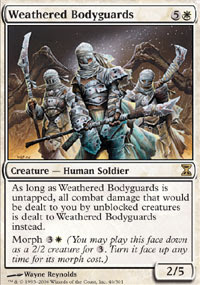
Neatly enough, that harkens back to one of our first examples, where the players will object with "But now they know about the Bodyguards!" Just like in a previous example, they failed to be clear, and now additional information is available – unfortunate, yes, but neither significant nor exceptional.
One more interesting point, somewhat illustrated by this last topic, and somewhat implicit from everything else we've said – shortcuts that aren't clearly stated in here should be established in some manner before they're used.
The list of shortcuts is not exhaustive. It is not intended to be, nor become, exhaustive. It is intended to provide clear examples of the philosophy we want our judges to use as their guide, when you encounter unusual situations that don't match any of the listed shortcuts.
Well, we certainly hope you've enjoyed this rambling run through the Shortcuts. More than that, we hope that it makes a lot more sense now than before. And if not, then your questions become our top priority!
www.wizards.com
Wednesday, November 14, 2007
The Effects of Tier 2 Philosophy on Skill
I am playing the match Angelfire mirror. This is a fairly common deck with a very basic level (Compulsive Research, Wrath, Lightning Angel, Lightning Helix, Court Hussar, Signets, etc..) We are both at six life. I have three cards in hands, and none of us has any creatures. My opponent thirteen manna sources and three cards in his hand. He maintained an open blue in the last four or five laps, indicating my opponent that I have some sort of blue manna two instantly. My opponent is based, for its part, plays its fourteenth source of manna, and Demonfires me for six, planning to go on my right-back and do it again. [He has two Wraths in hand, so he can not go hellbent and kill me in that way.] 
Stop for a minute here. This group is commonly referred to run four of Return as its sole counterspell-at least among the "netdecker" community. Is that my opponent skill expected this manna two costs a blue card that Remand? Should have thought of each such card in the rule and tried to play each (even if he knew all)? Or is the correct play only expect the obvious choice?
I do not really know, but I know that I played alongside the Odds Odds / / Ends, copied the Demonfire and sent him back to his face for the win. Is skill in deckbuilding process that I played Odds / / Ends Over Refund? Is skill that I made it clear that I had some card in his hand that could be Refund? Are Odds / / Ends even "play", or should be considered only a lucksack that won much lower in a card? 
I do not think you can argue that calculating what is in the hands of your opponent is not part of the skill inherent in this game, like Poker. The difference is that in Poker you always know what 52 cards you are looking for. I do not know if I would say it's a problem, but this area of skills development is very disturbed by Wizards' new policy of "flooding the format with Tier 2 cards."
Perhaps the ability to speak here has changed. Perhaps the ability to concentrate on is not figuring out his hand, but instead of making subtle number and card so you can make changes as these works, fooling your opponent into a false conception of what is in your own hands. But you still want to know what is in his (or her).
In the past, netdecking for better or worse this simplified process for everyone. There was better covered with a more refined list and could count the number of Ode to Tourachs in their cemetery to see if it would be likely to be sustained in its wrath of God by once again without snagged away. Now, netdecking has only grown, but the typical magical player has every reason to sit down and say, "Maybe this second Bogardan Hellkite must Numot, Devastator." And I do not think you can easily say s / he 'd be Evil.
I do not want you to think that reject the Wizards' new policy here. Undoubtedly shakes and makes things players think for themselves, on their own plates and plates of their opponents. I want us as competitive players to think about how to deal with this new challenge to light, both in construction and in the platform game. 
First, when building your deck, in a slot that now there is a sea of options for the card. My challenge to you is: Think For Yourself. If you are losing until after the anger and Spectral Forces Giant Solifuges but still want countermagic against blue control, perhaps Odds / / Ends actually exceed Prison for you. If you think it is more important to create the first laps and keep his hand stocked, Remand perhaps will be better. Only you can decide. I learned that this weekend at Angelfire my deck, and Teferi Boom / / Bust excess that were unnecessary in the matchups were designed to inefficiency and matchups where I wanted Hellkites and Demonfires. I do not learn from this Frank Karsten true that the excellent article on the upgrade of this group with Planar Chaos. This seems to be the primary objective of Wizards, in my opinion, with this new strategy tier two: netdecking is no longer enough. 
As far as actual game, I think the best advice I can give is to calculate the hands of your opponent is not as important as it used to be. Step one is to think about what kind of things can happen, then close down as much as you can, then go with certain cards. In the example at the beginning of the article, the best thought process here is:
1. My opponent has clearly signaled that it has a blue two manna moment although it may be bluffing.
2. [Should I try to stop the game now?] My opponent has not shown any threats in the last shift, but he is constructing its part, and could easily kill me in one shift with the aim of making X creature or spell .
3. [My Demonfire received?] My Demonfire this in turn survive a Remand as well as a Mana Leak or Rune Snag. It is not going to survive an Odds / / Ends, and, indeed, you could lose in this scenario.
However, I think this makes it clear that my opponent made the right choice, given that he was going to kill me, which in turn. You may not have even thought of Odds / / Ends, but it is much less likely than the other three letters, and even then his work would have survived three out of four of these cards. You could argue his best game may have been emitted into the Wraths or at least one, and then go for hellbent next shift. In fact, what I like about this theory is that the hellbent Demonfire takes this discussion further, and only completely ignores the side of the opponent (with the hassle Commandeer exception). That play certainly strength in my hand to kill him now or face the obvious in the way hellbent Demonfire. But, in all honesty, had no reason to expect anything so closely resembling a "hard" against. 
So perhaps the answer is always playing the worst possible scenario. Or perhaps the answer is a backup of a step. Maybe we should reconsider our deck construction so that it can ignore our only covered to a greater extent what our opponent is doing, or rather on the planning done. And perhaps this is a subtle instrument Wizards to keep aggro decks near the top in a control metagame, unprinted obvious powers such as Isamaru, Hound of Konda.
The purpose of my article is not to give answers, but the question to instill in his own mind: how can I cope with the effects of too many playables? I suspect that there is no answer, and I suspect that makes people Wizards R & D very happy.
By aldaryn
Friday, November 9, 2007
Tempo and You by Scott Wills
Many times over the last few months you will no doubt have read various writers, including myself, talking about the Kamigawa limited format as one which is very tempo oriented. For some Magic players that phrase is an obvious one, and one which they feel they understand well. I have had a few e-mails recently asking for a more in depth explanation of what tempo is, and how it can be used, gained and lost. That will be the topic of today's article.
What is tempo?
The non-musical definition of tempo is something like: “A characteristic rate or rhythm of activity; a pace”. In Magic it's basically a term that refers to your ability to utilise various aspects of the game, such as mana and life totals, to your advantage. Imagine a theoretical game of Magic where each player had a deck full of lands and 2/2 creatures that all cost 2 mana, but that can't block. If you go first, (assuming you draw a reasonable number of lands and creatures) you win. You attack for 2 on turn three with your first guy. Your opponent attacks you back. You attack for four on turn four with two guys. Your opponent attacks you back. You attack again on turn five, and you kill your opponent on turn six, the turn before you die. Why did you win that game? Obviously, it's because you went first. But in terms of tempo what did that gain you? Quite simply, you had access to two mana the turn before your opponent did. That enabled you to establish tempo over your opponent, and with those theoretical decks there was nothing they could do to get it back.
I'm sure many (if not all) of you have lost a game of Magic the turn before you would've killed your opponent simply because you lost the coin-flip and were forced to go second. That was a loss to tempo. The above example illustrates perfectly why it is almost always correct to go first in a game of Magic, and certainly in the Kamigawa limited block. There are some limited formats which are slow enough that card advantage is more important and in those formats you might choose to draw first, but those formats are few and far between, and the Kamigawa limited block certainly isn't one of them.
As I just mentioned, tempo can apply to different areas of Magic. At its most basic level it simply applies to your mana. If you have a Grizzly Bears and your opponent has a Gray Ogre then you both achieve the same thing when casting them, but you gain a mana. Sometimes this will mean you get an advantage because your creature comes into play earlier and is able to attack first, sometimes it means you gain an advantage because you're able to use that extra mana to do something else. You've gained tempo. Sometimes of course it won't mean anything if you're unable to use that extra mana, but the potential is there.
Similarly, sometimes you can use a cheap spell to nullify a more expensive spell of an opponent. Your opponent spends their sixth turn casting Keiga, the Tide Star; you spend your sixth turn casting Cage of Hands on Keiga. In that situation you've gained three mana over your opponent and hopefully you'll be able to use that mana to perhaps cast an extra creature or spell. Once again, that is tempo you have gained.
This is the whole reason why people talk so extensively about mana curve. If your deck has a good mana curve with many things to do for small mana costs then typically you will have a greater chance of being able to utilise your mana in the early turns of the game, and also have a greater chance of using any spare mana you might have in later turns. Decks with low mana curves have them because they want to establish tempo in the early part of the game and use it to help them win.
The other thing that impacts tempo in a game of Magic is the life totals of the players. Typically whichever deck is the more controlling deck in a particular match-up has to sacrifice its life total early on before it can hopefully try and restore the tempo balance with it's more powerful spells later. The aggressive deck would start out gaining tempo with such cards as Goblin Cohorts and Villainous Ogres and so forth, but once the controlling deck gets it's more powerful spells online it would hope to be able to stabilise the board and restore the tempo balance. The aggressive deck simply wants to reduce its opponent's life total to zero before the controlling deck is able to re-establish that balance. If it fails, then it has to fall back on cards which are capable of dealing those last few points of damage through evasion such as Nezumi Cutthroat or other methods like Frostwielder and Devouring Greed. If the controlling deck has had to sacrifice too much tempo early on then its life total will be low enough that the aggressive deck's finisher wins it for them.
Now historically the colours of black and red have been the colours of aggression and blue and white are the more controlling ones, but that doesn't have to be the case. If the blue-white deck starts off with Isamaru, Hound of Konda, Kami of Ancient Law and Soratami Rainshaper, then it would be the black-red deck that was probably behind on tempo and that would have to try to re-establish it. No matter what colours you draft and play, it's always important to determine whether you intend to be the aggressor both during the draft and during a game.
There are often cards that effectively trade life for mana and occasionally vice versa. These can be very useful in establishing and maintaining tempo. Spells like Vendetta and creatures like Takenuma Bleeder allow you to trade life points for a cheaper mana cost. As long as you can maintain the tempo they help establish, the cost of a few life points will be completely irrelevant. Similarly you can also have cards that work in the opposite way, in that their primary role is to trade mana for life. Cards like Kaijin of the Vanishing Touch illustrate this. This card is never going to help you win the game. It won't kill your opponent or run them out of cards. However what it does do is basically trade two mana for a number of life points. In most situations it will completely negate a two-power attacker and force the opponent to re-cast anything they do attack with. You'll probably get a net gain of at least two mana from this while preventing some damage at the same time. Of course you do also risk the chance of it being useless if your opponent kicks off with Nezumi Cutthroat and Soratami Rainshaper but usually cards like Kaijin of the Vanishing Touch go a long way in preventing the aggressive decks getting a big head start on you.
Tempo and tricks
One of the main benefits of maintaining tempo on your side is that it often allows you to use your combat tricks before your opponent's tricks come online. Imagine a game where you win the flip and you start off with Kami of Ancient Law and Ronin Houndmaster on turns two and three. Your opponent's first play is a Kami of the Hunt on their third turn you play a fourth land and attack. Obviously they can't block the Houndmaster, but should they block the Kami? They'd be on only 12 life if they didn't, but they'd be leaving themselves vulnerable to all sorts of tricks if they did. Even if they block and you don't have a trick you've still gained a mana on them as the Kami of Ancient Law cost only two to cast against the three mana they spent on their Kami of the Hunt. If you are able to just cast an Indomitable Will or Blessed Breath and follow that up with another creature then you put them in real trouble.
If we give the green player the first turn play then you would play the Kami on turn two, and they would play their Kami of the Hunt on turn three. You can still cast the Houndmaster on turn three and attack with both of your guys but in that situation the green player can trade the two Kamis off without any fear of combat tricks. They might then be able to follow up with an Order of the Sacred Bell on their next turn that would start to swing the damage race into their favour.
Lets modify the situation a little and change the green cards. This time they are going first and they start with an Orochi Sustainer on their second turn. You follow with your Kami of Ancient Law. They then make the Order of the Sacred Bell on turn three. You can make your Houndmaster and attack with it, but then you take four damage when the Order attacks you back, and maybe your opponent follows up with a Feral Deceiver (with mana open to check the top card of their library) or a Frost Ogre. In this situation you've had exactly the same draw but your opponent has established a much greater tempo advantage than you. Perhaps your only fourth turn play is a Kami of Fire's Roar. In that situation you'll be in a lot of trouble when your opponent attacks with their guys on their fifth turn as you're now the one who is tapped out and vulnerable to combat tricks.
These examples aren't uncommon game situations and they're quite typical of the first few turns of Limited Magic in this block. Hopefully they do a good job of illustrating why tempo is important and why you should care about it when drafting, building your decks, and playing your games.
Gaining and losing tempo
Now that we've established what tempo is, and why it's important, it's worth taking some time to look at different ways you can gain and lose it.
Equipment is one subset of cards that can be big losers in tempo terms. No-Dachi is a perfectly good example of this. It costs two mana to cast, and three to equip. Lets say for example you cast it on your fifth turn and then equip it to your fourth turn creature and attack. Any removal spell from your opponent gains them a lot of tempo there as you basically lose the casting cost of the creature and the equip cost of the No-Dachi in return for them casting their spell. Typically you'll be losing three or four mana in that trade. If they have a bounce spell the situation is almost as bad as you'll have to recast your fourth turn creature and then wait another turn before you can equip No-Dachi again. That's a lot of time and mana spent getting back to the exact same situation you were in two turns previously. Now there are some equipment cards like Umezawa's Jitte that are powerful enough that you don't care about the loss of tempo and others that are cheap like Lightning Greaves or Ronin Warclub so that they don't impact your tempo in as big a way.
Card drawing effects or anything that doesn't actually affect the board would be a loser in tempo terms. Counsel of the Soratami isn't a good card to have to play on the third turn as you may find the loss of tempo overwhelms you before the extra card has time to impact the game. Consider a situation where you're going first with an opening hand of:
You lead with the Akuba and the Ronin and hit your opponent for two on your third turn. They untap. Of all their possible plays, what's the one that you most want to see? It's pretty much either Counsel of the Soratami or Kodama's Reach. Either of those plays lets you untap, attack for five and (assuming you've drawn a land in three turns) drain them for two with the Akuba and cast the Deceiver. Your opponent would be on eleven life, facing down seven power's worth of attackers and you would have a removal spell in hand. That's probably game over a lot of the time. And all because their third turn play didn't affect the board.
Expensive reactive cards are also a big loser in tempo terms most of the time. Mostly I'm thinking about cards like Second Thoughts and Chastise and anything that requires you to sit back with a lot of mana untapped and do nothing. If your opponent can correctly read your hand they can play around either of these by simply not attacking and instead continuing to develop their board position. They can wait for a point in time when they either have an answer to your spell or when it's simply not as relevant for them to lose an attacker to an expensive spell. Meanwhile you fall farther and farther behind as they keep casting more threats and you have to keep holding your mana open for Second Thoughts.
In the same way that you can lose tempo from individual cards you can also gain it. Ghostly Prison is a good example of such a card. Imagine a similar example to the last one where your opponent leads out with a Wicked Akuba and a Nezumi Ronin and they have Befoul and Kami of Fire's Roar in hand. You then drop Ghostly Prison on the third turn. Now they have a tough choice. They could spend their whole fourth turn paying four mana and attacking for five but this doesn't develop their position at all and they can't do that as well as casting the Kami of Fire's Roar. If you make a creature on your fourth turn, they can either pay to attack into it or cast Befoul and forego any attack at all.
It's even worse if you go first. They play their Akuba on turn two, and you follow with Prison on turn three. Now they can't attack at all if they want to cast the Ronin and if you make a suitable blocker they'd again have to skip an attack step in order to deal with it via their Befoul. In this situation Ghostly Prison gains a huge amount of tempo for you.
This example also relates perfectly back to my point about being aware of whether or not your deck expects to be the aggressor or not. If you lead with Goblin Cohort and Kami of Ancient Law how useful is that Ghostly Prison on turn three then? Not very. Ghostly Prison is one of a few cards whose sole purpose is to create tempo. If you already have the tempo advantage anyway then it literally does nothing and should not be included in your deck.
It's important to recognise the distinction between card advantage and tempo advantage. The aforementioned Ghostly Prison is a perfect example. It doesn't do anything by itself; it doesn't kill a creature or attack your opponent. In effect, all Ghostly Prison does is allow you to basically trade the card for your opponent's mana, but then that is what tempo is all about. Quite often tempo doesn't care about card advantage. Bounce spells can and often should be used just to create a tempo advantage, even though it's a loss of card advantage.
The more powerful cards in the game are those that can both generate tempo and card advantage at the same time. From this block Hideous Laughter is a good example of this. If your opponent starts off with Frostling, Kami of Ancient Law and Kitsune Blademaster then not only does your Hideous Laughter gain you a three-for-one card advantage but it also steals a tremendous amount of tempo from your opponent too. You've wiped out their first three turns for just four mana. Once again though, if you expect your deck to be the aggressor and the one that establishes tempo early on, then Hideous Laughter loses a lot of its power.
Summing up
I hope I've explained the concept of tempo clearly enough. This article is not intended to be a comprehensive study of the subject, merely a useful primer for those of you who feel you wanted a better understanding of the concept. Hopefully it's given you some insight into why tempo is important and the different ways you might be able to establish it or steal it back from an opponent.
By Scott Wills
Tempo
Part 1. What is the pace and with it than eat, "or from the author"
What is a Tempo? Tempo is a sign designating it as "painful" game for us one way or another card. In a nutshell this is not to explain, so we will need many examples. Go!
Part 2. Speed is everything
The main concept in the theory of the superiority of the pace-speed card. The term includes two sub:
The speed at which the card is played
Moment of the game, which was played card is making its impact in the playing situation
Let's talk about it in more detail.
The speed at which the card is played determined, as a rule, the very type of card. Thus, any card type "Instant" speed higher than for card-type "Sorcery" or Enchantment. A map of the Grizzly Bears speed lower than that of Ashcoat Bear. What is the meaning of this?
As simple. Suppose Game trivial situation in which the opponent is on the table Grizzly Bears (remarkable animal), and in your hands desyatochny Incinerate, Volcanic Hammer and we assume Mana Leak. Your move, you control one island and one Mountains, the two are ready for use. There are several options for the distribution of your opportunities. First-shoot Volcanic Hammer in a bear and transmit turn. The second is simply to convey the course. In the first case, you guys erased enemy, but opponents receives superiority on the pace at 2 Oman. Because in the beginning of his during his land will be 2 ready, and you have none. In this case, correctly refer the course and wait for an opponent that will happen.
If he decides to play a dangerous card for 2, and better for 3 Oman, you can interrupt her c leak through maps Many, having superiority on the pace at 2, and even in 3 units magical energy. If nothing is suggested you with a clear conscience send to hell in a bear through the end of Incinerate. In any case, the opponent does not receive superiority means, you play correctly.
The other side of the issue-point game, which was played card is making its impact in the playing situation. All perfectly known map of Birds of Paradise certainly is, is very good. After all, she and disperse us, and stabilizes manabazu, in general, doing everything that needs to be. On the other hand, a time when it really affects the playing situation during the first three or four. After all, you do not want to raise it on the fifteenth way when you need a critical, say, finishment or won a Loksodonsky Ierarh? In time, in Tip2 Mirrodin / Kamigawa was strong deck with unique concept: Plow Under opponent crushed several moves (Eternal Witness + Crystal Shard), and then put any kind finishment Meloku, The Clouded Mirror or Keiga, the Tide Star, and the opponent nicely ordered a few moves. This deck is not reached great success, yet not once broke in the first place neslabogo a tournament in Japan. What is the players were surprised when they found that the leaf is different from the popular only two things - a lack of Birds Of Paradise and spleshem to white sake Ethereal Haze in Sidon.
And why you did not play birds? - asked the championship.
"I do not want to raise it during the twelfth, much better land.
That is true.
On the other hand, there are maps, which has life cycle in the later followed, and the need to be neat when you turn them in its "deck. A striking example is Karu-zemli like Boros Garrison. Such land advisable to play only in a late game-otherwise attacked rate can be appreciable.
So, apparently this part of today's subject razobralis we can move on to the next part.
Part 3. … Slow down or accelerate?
This part must begin by entering new term, a large part of the famous and not very powerful wizards, "Droubek". The educated of the two English words (Draw & Back-Drawback, receive back), the term refers to some effect, most often negative, which we get in a game card. This is opposed to positive effect. To cite examples:
Phyrexian Arena allows you to take additional card every turn. Droubek this map, it is clear that it is as "regular" shooting at you at 1.
Perilous Research for the two Oman raises you two cards that very, very well. Droubek-sacrifice Permanent several holiday breaks.
If this all clear to proceed to the main-made for what initially this chapter. In a world of magic, there are several major classes decks of them - Agro, control, combo, agrokontrol-known to all, so I will not talk about their differences. I will be a lot of talk on the methods of acquisition tempo-prevoshodstva in each of them.
The aggressive use of a deck of the most primitive method-call it passive superiority on the pace.
Normal creature one manat has characteristics 1 / 1. If it is above characteristics, then it involves any appreciable droubekom. Superiority aggressive decks built on the fact that they did not spend on the pace-note droubekov them or not, or they plyuyut. Isamaru, Hound of Konda, Savannah Lions, Kird Ape-each of these creatures gives tempo-prevoshodstvo ran as thick guy for 1 manat and without droubeka. Agro-kolody enjoy this intensively. Generally speaking, the use of a large number of maps with manakostom small and large impact on the game already have superiority on the pace. But most of this superiority has Droubek raskidav-hand and going to topdeka mode, you can easily be sent to your opponent on the true path nedeyaniya.
Deck marked "control" method used by most obvious superiority on the rate-active superiority. This method is that, as a rule, in order to break down the threat Oman requires less than to establish that threat. The other side of monitoring is that it is often closed the road to mana-akselleratsii. He could not afford to play during the second or signet Sakura-Tribe Elder, because from that moment begins "control" time - a time when control is working, posting all one hundred. When this time ends (for example, after the Wrath of God in the stage when the opponent has already played with topdeka - approx. Magic God), to play mana-akselleratsiyu too late, because the required number of sources already have, otherwise would control simply did not live to see this the time (s genius wins out skryu not take into account). In addition, for the benefit of the glorious cause of tempo-prevoshodstva works by the fact that 80% of the control nemanovyh cards have a "Instant", which means that play on my swing, we will start only when there is a need to install finishmenta.
Aggro-Control. This is a very complex concept, so its methods tempo-prevoshodstva we will consider the examples of two decks, each other is not quite similar: Rock and his Millions and UW Trinket
Aggro Rock Dave Shiels 2005 Grand Prix Charlotte, NC, 3-4th place
4 Birds of Paradise
3 Eternal Witness
1 Genesis
2 Loxodon Hierarch
1 Ravenous Baloth
4 Sakura-Tribe Elder
2 Withered Wretch
4 Cabal Therapy
1 Cranial Extraction
3 Gifts Ungiven
1 Haunting Echoes
3 Living Wish
4 Pernicious Deed
4 Putrefy
1 Smother
5 Forest
1 Island
4 Overgrown Tomb
1 Plains
2 Polluted Delta
1 Swamp
1 Temple Garden
1 Watery Grave
4 Windswept Heath
2 Yavimaya Coast
Very, very strong Deck, presented before us in the section-you can see everything. Not shown here is only one - where is it, the pace of superiority? Its that, no?
There.
4 Pernicious Deed
4 Putrefy
1 Genesis
3 Eternal Witness
4 Cabal Therapy
3 Gifts Ungiven
4 Sakura-Tribe Elder
4 Birds of Paradise
Really big piece if honestly. Well, with birds and Startsami Tribe Sakura all clear and true. Pernicious Deed is a mad superiority. If on the table 3 Permanent with the price or less prone to detonation Pernicious Deed, it establishes the superiority of three times. If a 5-to five-fold, respectively. One more and he explodes at a speed of "Instant", beauty.
Cabal Therapy-map establishing superiority implicit manner. Obsolete dangerous opponent with the hand, we are creating a map of the superiority of Oman needed to eliminate this risk (minus Oman needed to install proper risk). Moreover, the card enables recursive-play himself twice.
I think rest is fairly understandable, but if not more so, it is an incentive to think on their own.
UW Trinket Runtao Sun 2007 PTQ Yokohama High Wycombe, England, 5th place
2 Exalted Angel
3 Trinket Mage
4 Azorius Signet
1 Chalice of the Void
3 Decree of Justice
1 Engineered Explosives
3 Fact or Fiction
2 Mindslaver
4 Remand
2 Repeal
1 Sensei's Divining Top
2 Spell Burst
4 Thirst for Knowledge
1 Tormod's Crypt
3 Wrath of God
1 Academy Ruins
3 Adarkar Wastes
1 Ancient Den
4 Cloudpost
4 Flooded Strand
4 Hallowed Fountain
3 Seat of the Synod
4 Vesuva
Despite the fact that the deck closer to control its position as the author Agro-Kontrol. And who we are to argue with the author?
The main method tempo-prevoshodstva Cloudpost here. First, it creates us 1 poteryanuyu manat because of present the. But for the second consecutive correct it. And in a deck of 8. Mon. There still has one engine, but to leave his homework novice magician =)
Combo. Combo deck using a direct method tempo-prevoshodstva, namely a clear superiority on the pace. It is the exchange of maps in Oman.
TEPS Ryan Gin 2007 PTQ Yokohama Oklahoma City, Oklahoma, 1st place
4 Burning Wish
4 Cabal Ritual
1 Chain of Vapor
4 Chromatic Sphere
4 Chromatic Star
4 Chrome Mox
2 Infernal Tutor
4 Lotus Bloom
3 Mind's Desire
4 Rite of Flame
4 Seething Song
3 Sensei's Divining Top
2 Sins of the Past
1 Tendrils of Agony
4 Ancient Spring
4 Gemstone Mine
4 Geothermal Crevice
4 Sulfur Vent
Wishboard:
1 Channel the Suns
3 Defense Grid
3 Duress
3 Empty the Warrens
1 Hull Breach
1 Mind's Desire
1 Pyroclasm
1 Sins of the Past
1 Tendrils of Agony
4 Rite of Flame
4 Seething Song
4 Cabal Ritual
4 Chrome Mox
4 Ancient Spring
4 Geothermal Crevice
4 Sulfur Vent
In my opinion, everything is clear.
Part 4. Conclusion
The conclusion will be short-correctly use the momentum to you over this, and you will not be any gambling problems.
