How to collect Elves: The basic colors.
If you take the first or second peak Garruk Wildspeaker or Imperious Perfect (if you saw these draft top peaks, most likely you will take it over other), then you will just play green. These cards are really good not only in a deck on Elves, although there, too, but in their own right: Garruk simply wins the game (though it's best not to stand too early, and the first play "+1" ability to untap lands, to keep the bomb capable decide the game) because it is hard to kill, but to produce many tokens and let all creatures start in a decisive attack. A Imperious Perfect favorably differs from many other "Lords" that does not necessarily to draft just Elves: he is able to create and deliver an opponent a lot of trouble, if the couple of turn he will be in game. But certainly if it will be drafted with fellows that would be great!
There is also good elves such as Elf Masked Admirers and Nath of the Gilt-Leaf, and the Wren's Run Packmaster (although it is desirable to play it on the table when there are at least two Elf to avoid early death), but these are rares and you will see them rarely. Turning to the less rare cards.
Without decent common Elves would not be at draft worthy archetype, but fortunately, we have the present man-Lys Alana Huntmaster. Not all value it highly, and often as not they walk very first peaks. But this at least Filler 3 / 3 for 4 mana (albeit with a double cost) as well as a maximum-much more. If you drafted at least two or three later than the middle of the second booster, start taking strong Elf, no regret. Namely: such a remarkable ambush as Gilt-Leaf Ambush, such a decent second drop, and the source of the second Green mana, as Leaf Glider; and searcher Elvish Harbringer (although he had already uncommon) is not redundant. They and of themselves good, and if we are on the table worth Chief Hunter Liz-Alany, all together elves able to show the enemy the sky of diamonds.
Slightly less good but still are a variant of such cards, as Gilt-Leaf Seer and Moonglove Winnower.
Removal plus Elf-Eyeblight's Ending, do not miss. Remember, too, Elf-simulator, so much the second time elven color-black, among others please note card such as Nameless Inversion. Average quality changeling(type Woodland Changeling), add to taste, to make land, place and start to deliver the arm.
If you can recruit a significant portion of listed above (commons and at least one decent rare Perfect either), then I guarantee that your opponents will have to behold.
But it is quite possible, even likely that entirely you will not be able to collect on the deck of Elf. There is no afraid. Consider first that can be added to the green (the primary color of elvish deck) and black (the second most important elvish color). Just want to say banal: add a good card, tentatively draft them. But try to indicate what would be the most preferable, given the shortcomings lacks.
What are their weaknesses? Well, on the ground, ideally it is not simply equal percentage, but fly elves do not know how. Here we can help flyer blockers, like Cloudcrown Oak, but perhaps more effective removal prove, and if you have a lot of Nameless Inversion and Eyeblight's Ending, but you have to take Shriekmaw, and its add-its draft bomb. Removal on draft generally acclaimed, and in combination with Elf removal winding up the mountain, and removing flyers not giving another dangerous archetype - Merfolks-collect their kombs: they comb with each other today, we will soon! Regarding Merfolks: it is more than true, because, even if you gather on the ground and fantastic and gigantic army, but will not be enough removal, Merfolks, combined simply do not let you win.
If, for example, the Goblin, all on the contrary, will kill many of our creatures, so try to get at any price advantage on the cards. Here we help these cards as Ambush, which raises two Elves for a spell; also try, if there is a time and mana to the Chief Hunter Liz-Alany and on the same play during another one or two Elf; then, and even if Hunter murder, we have to get him the advantage.
Yet sometimes hinder armies of Elves may removal massive, but I do not recall many such draft LLL effective cards, is that the white team, but before it even have to live (and draft it is not easy: it is the CRP, in addition, to build on it a deck is not always).
As collect Elves: that it is possible to add other colors.
If you draft Elves, green draft you must, however, it may become more of you are not black; il in the third color want to leave. What to do? Tell you.
To call will only commons as most often catches cards; uncommons royalties, and still we will most likely mainly flowers / primary colors.
Well, first of all, remind about Changeling in many colors other creatures and other worthy of this type will not enumerate.
Changeling addition, however, there are other cards in blue, for example, because we need to stop flyers, come tappers (Stonybrook Angler), its flyers (well, if ambush instance, Persermite but not Time Glen-Elendry worse card), but as soon flyers will tap (alone or our efforts), Glimmerdust Nap reassure them.
Ponder help get it main Elf. And just blue Common, which falls in love (almost) draft Deck with blue, and the Janjaweed and drifter - Mulldrifter.
What exactly blue advised not to play, it is Captivating Glance too unreliable card.
Consider the red-here we have not tappers, and indeed flyers a little, but how come removal Lash Out Consuming Burnfire and to a lesser extent (as kills fewer hazardous substance) Tarfire. But black removal usually more universal, and fishing blow of Elf, we need not always so, and not too often they add red-faced is it that if you really drafted lot of these cards and relatively decent creatues, including Changeling creatures.
And quite a bit of white. Clearly deserve a place in a deck (of commons) Oblivion Ring and tapper-Kithkin mana for 1 white, but as a good alternative-drifter enemy flyer - Plover Knights (though here and double COST, but doublecolored deck with a large number of mana stabilization-can) .
A final touch-the artifacts. Moonglove Extract is not tied to the color removal-finishing blow - slow motion, can be put. And great card and for doublecolored decks doubly Wanderer's Twig. It will save you from the flood and screw. Just play it. 1-2 pieces.
Well, thanks for reading. I wish success to Lorwyn draft on Elves!
Wednesday, December 19, 2007
Lorwyn Draft. Elves.
Friday, December 7, 2007
6-0 Draft with Adam Chambers
Adam Chambers is a Pro Tour regular who can usually be found working with the likes of semi-retired Tim Aten to prepare for Pro Tours. At this year's World Championships he dug himself into a bit of a hole during the Standard portion, starting the event 0-4, but he's been hot since then, winning every single match he's played. That streak includes a 6-0 run during the Limited portion of the event and when the aforementioned Aten informed the coverage staff that Chambers's view on triple Lorwyn draft was truly innovative and that his performance was not simply a fluke, we couldn't help but take the chance to sit down and talk with him.
On the question of whether or not one should play eighteen lands in their draft decks or risk trimming one or two to squeeze in extra playables, Chambers came down firmly on the side of caution. "I find that I'd much rather play eighteen lands than some card that isn't meant to be in my deck or isn't going to be very good." He admitted that occasionally he'll trim a single land if he feels his curve is low, he's playing lots of cantrips, or he has lots of additional mana fixers, but his lists will usually feature the full eighteen mana sources.
And on drawing or playing first?
"I always draw first, no matter what. I like to have more information as you need to know what to kill to win the matchup and you simply have more cards than your opponent."
Was he worried about being out-tempoed in a format generally credited as being fast for Limited?
"It's not like I disregard mana curve; it's just that I think cards are a lot more important than tempo."
Chambers clarified what he meant by knowing what creature you have to kill in a matchup by saying, "In this format I find that every time I draft, all I do is pick removal. Every deck is going to have whatever creature it's based around and you're going to have to either kill them or lose. Dreamspoiler Witches in Faeries or Lys Alana Huntmaster in Elves or Silvergill Douser in Merfolk... pretty much all Merfolk, actually. I always pick removal in the early picks."
Anything he doesn't like drafting?
"I don't know how to win with white, and I won't draft it no matter what." He also violates one of the most sacred conventional wisdoms of Lorwyn draft: he doesn't search out a tribe to pick up. "I don't really look to draft the tribes. If they come I'll draft them or if I open some card, like Thundercloud Shaman maybe, I'll draft them, but I find that removal is more important than tribes. If you take away the key creature, the rest of the tribal cards aren't too good. If you can kill the creature a deck is based around the rest isn't so good."
Chambers typically tries to start a draft by picking up Moonglove Extracts and Weed Strangles but did have one uncommon he always keeps an eye out for: Marsh Flitter. "If I see it I almost always pick it. It's very good and works great with a number of the black cards. If you want to play a defensive game with the card it's really hard [for your opponent] to do anything about it without getting at least a couple of your opponent's cards. It's one of the best plays for turn four."
Sometimes it pays to think outside the box and for Adam Chambers it meant a decent shot at the Top 8. Here are the draft decks that put him in that position, with the second being, in Adam's words, "Theoretically the deck I want to draft every time."
Adam Chambers’s Draft Deck #1
Worlds 2007
Main Deck:
11 Island
6 Swamp
1 Aethersnipe
1 Amoeboid Changeling
1 Benthicore
1 Dreamspoiler Witches
1 Glen Elendra Pranksters
1 Guile
1 Merrow Reejerey
2 Mulldrifter
1 Paperfin Rascal
2 Silvergill Adept
2 Streambed Aquitects
2 Warren Pilferers
1 Broken Ambitions
1 Ego Erasure
1 Footbottom Feast
1 Jace Beleren
1 Nameless Inversion
1 Whirlpool Whelm
1 Wings of Velis Vel
Adam Chambers’s Draft Deck #2
Worlds 2007
Main Deck:
9 Forest
9 Swamp
1 Dreamspoiler Witches
1 Ghostly Changeling
2 Kithkin Daggerdare
2 Marsh Flitter
2 Moonglove Winnower
1 Mournwhelk
1 Spiderwig Boggart
1 Thieving Sprite
1 Vigor
1 Warren Pilferers
1 Woodland Changeling
1 Footbottom Feast
1 Incremental Growth
1 Makeshift Mannequin
2 Moonglove Extract
3 Weed Strangle
by Bill Stark
Thursday, December 6, 2007
PTQ Chicago - *2nd*
At the Indianapolis PTQ the weekend prior to Chicago I had the misfortune of being paired against David Felske. I say “misfortune” not because Mr. Felske was less than pleasant to play against (quite the contrary actually) but because his sealed pool was extraordinarily strong. I don't just mean “good” or “broken” but insanely powerful and extremely difficult to beat. Double Elvish Magistrate, Imperious Perfect, double Shriekmaw, Changeling Hero, a Primal Command to tutor for those creatures, an Elvish Harbinger to tutor for his Elves…the list of strong plays his deck was able to make went on and on. After a sound thwacking at the hands of that nonsense I had the chance to speak with David who had made an 11 hour trip one-way to make it to the PTQ. He informed me he was from Canada and that his friend, Mark Cavaco had done the driving.
Mark mentioned he had read some of my work previously and we struck up some conversation throughout the day. He informed me he'd be in Chicago the following weekend, and I assured him I'd be there and that I'd keep an eye out for him. Our talks there revealed some fascinating information about the Ford Co. employee from London, Ontario.
It turns out Mark was actually on the third trip in a series of four for the Kuala Lumpur PTQ season. At Canadian Nationals this year he hatched a simple plan: with a contingent of friends he'd hit up PTQs in Detroit, Indianapolis, Chicago, and Cleveland in an effort to earn a plane ticket to Malaysia. He even had t-shirts made for the road trip series for himself and his compatriots (“They were supposed to say ‘Team Randomz'” he explained “but the printer put a space, so I guess now we're Team Random Z.”).
How successful had they been so far? Mark explained they had won Detroit at the lead of Dan McDonald, and had put the aforementioned David Felske into the Top 8 in Indianapolis, though his strong sealed deck didn't do him any favors in the draft portion of the event and he was out after the quarters. Also making the occasional trip was Nassim Ketita who saw some success at Grand Prix-Philadelphia a few years ago though neither he nor Mark had earned the chance to play after the swiss rounds so far in the season.
Mark, who's married and has three kids, started playing in 1994 though he didn't get his DCI card until ten years later. He can often be found on Magic Online with his clan “Frat Broke,” a group he uses to prepare for the events he has to cross international boundaries to play. When asked how his family felt about his lengthy travels he pointed out that for the Chicago PTQ he had traded his teammates in to travel with his wife and children and that they were making a Christmas shopping weekend out of it staying in an extravagant hotel on Michigan Avenue and enjoying the sites of one of the United States' largest cities.
Throughout the course of the day it became apparent Mark was the type of guy who simply loves playing Magic. It might be easy to think of oneself as a road warrior when we drive the four hours to get to Chicago (as I had to do) but Mark thought nothing of driving a minimum of eight hours one-way to get to Indianapolis, or to tacking on an extra four hours on the way back to drop his car-mate David off at home. He also made the most of being at the Chicago event staying until the final round of the Top 8 had played out, soaking up as much as he could from the players still competing. At one point he even conceded a match that had gone to turns but was apparent he would probably lose given more time in an effort to helps his opponent pick up some amateur prizes. All around it was a pleasure meeting and talking with Mark and hopefully come the PTQ-Hollywood season we'll see him back in Chicago and Indianapolis. Whatever happens it was refreshing to see someone who enjoys Magic enough to make such an effort to play.
Mark Cavaco, truly a road warrior.
The Pre-Tournament
The plan to get to Chicago was for Blu McFarlane to meet me in Iowa City from Cedar Falls, then for Cheeks and Gabe Stoffa to meet me from Ames after which we'd pile into my Cavalier and drive to Chicago together, staying at a hotel. Unfortunately Blu had some things come up and had to cancel which just left it at three of us going. In that situation it's best to make lemonade, etc. so I gave Peter Martinez a call and he said with only three of us attending we'd be good to stay at his pad. Saving $90 on a hotel and getting to hang with PTM? Sweet.
The trip down was uneventful until we got to Peter's at which point in time we were bombarded with animals. Pete's family are enthusiastic animal supporters and have something like five dogs, each with a unique personality all its own. The one I was most struck with was “Toby”, a pure bred small breed something or other, though small is never a word you would use to describe him. You see, Toby's a bit plump and…well, here:
Toby the dog manages to even put some Magic players to shame...
We played with the animals, watched “Superbad” and then lost consciousness for 6-8 hours. The following morning we each showered, then left for the site with PTM directions in hand. Unfortunately Cheeks was our navigator. The thing about Cheeks is that he's a solid Magic player, but if you need someone to navigate, scrape ice, open a frozen door, get groceries from the store, in fact do just about anything but play Magic…let's just say he's definitely not your man.
Okay okay, I'm teasing him a bit and between Gabe in the backseat, me in the front seat, and having been to Pastimes' new store we found the place with no trouble.
The Pool
Some people enjoy looking at the sealed pool from a report to analyze and build it. Here you go:
WHITE
1 Brigid, Hero of Kinsbaile
1 Cenn's Heir
1 Crib Swap
1 Dawnfluke
1 Goldmeadow Harrier
1 Kithkin Harbinger
1 Kithkin Healer
1 Oaken Brawler
1 Pollen Lullaby
1 Sentry Oak
1 Soaring Hope
1 Surge of Thoughtweft
2 Wellgabber Apothecary
GREEN
1 Battlewand Oak
1 Cloudcrown Oak
1 Elvish Branchbender
2 Elvish Handservant
1 Fistful of Force
1 Gilt-Leaf Seer
1 Jagged-Scar Archers
1 Kithkin Daggerdare
1 Kithkin Mourncaller
1 Lignify
1 Lys Alana Huntmaster
1 Spring Cleaning
1 Woodland Changeling
BLUE
1 Aquitect's Will
1 Benthicore
2 Broken Ambitions
1 Ethereal Whiskergill
1 Glimmerdust Nap
2 Mulldrifter
1 Pestermite
1 Scattering Stroke
1 Sentinels of Glen Elendra
1 Tideshaper Mystic
1 Whirlpool Whelm
1 Zephyr Net
BLACK
1 Boggart Birth Rite
1 Boggart Harbinger
1 Boggart Mob
1 Dreamspoiler Witches
1 Eyeblight's Ending
1 Footbottom Feast
1 Makeshift Mannequin
1 Marsh Flitter
1 Mournwhelk
1 Nath's Buffoon
1 Nectar Faerie
1 Nightshade Stinger
1 Peppersmoke
1 Scarred Vinebreeder
1 Weed Strangle
RED
1 Axegrinder Giant
1 Blind-Spot Giant
1 Blades of Velis Vel
1 Caterwauling Boggart
1 Faultgrinder
1 Flamekin Bladewhirl
1 Hurly-Burly
1 Mudbutton Torchrunner
2 Soulbright Flamekin
1 Stinkdrinker Daredevil
1 Thundercloud Shaman
Artifact, Land, and Multi
Artifacts
1 Moonglove Extract
1 Springleaf Drum
Non Basic Lands
1 Vivid Grove
Gold
1 Nath of the Gilt Leaf
1 Wort, Boggart Auntie
1 Wydwen, the Biting Gale
I saw Wort, in my pool for the second time this season, and Boggart Mob and immediately aligned myself with the Goblin tribe. Upon further reflection, however, I realized the only thing to “abuse” with the 3/3 would be Boggart Birth Rite, Mudbutton Torchrunner, and possibly Crib Swap on a splash. That was not very exciting and I was at a loss as to how the pool should actually be built. After a while I realized there were a lot of flyers in the deck (I had been jamming the Mulldrifters into the Goblins pool come hell or high water…) and that playing UB with a tiny touch of green for Nath was well within my reach. Here's the list I registered and played:
1 Vivid Grove
1 Forest
7 Swamp
7 Island
1 Tideshaper Mystic
1 Nightshade Stinger
1 Nectar Faerie
1 Pestermite
1 Wydwen, the Biting Gale
1 Mournwhelk
1 Sentinels of Glen Elendra
1 Dreamspoiler Witches
1 Ethereal Whiskergill
1 Marsh Flitter
2 Mulldrifter
1 Nath of the Gilt Leaf
1 Benthicore
2 Broken Ambitions
1 Scattering Stroke
1 Whirlpool Whelm
1 Moonglove Extract
1 Eyeblight's Ending
1 Footbottom Feast
1 Makeshift Mannequin
1 Peppersmoke
1 Weed Strangle
The deck was built on a theme (“creatures that fly”) and that meant playing a few threats that might draw a raised eyebrow. Nightshade Stinger is basically a rehash of Cloud Sprite from Mercadian Masques and in limited the Sprite's nickname was “Lava Axe.” It earned that nickname because players would drop it on turn one and it would attack about five times. Eventually their opponent would have it dead with a removal spell or immobilize it with some form of blocker, but 5 damage is not insignificant. The Nectar Faerie was another also-ran but as Andres Rizner pointed out to me at Pro Tour-Valencia, if you're going to make a mistake, make a mistake! Come up with your plan and Execute on it fully even if it's not, as you find out later, the best plan to Execute on. I wasn't sure whether “flying” was good enough, but I was going to give it my best shot and find out for myself.
At first I felt my deck wasn't very bomby in that it didn't have rares which do things outside the Arena of being a creature. I understand Nath and Wydwen are both very good creatures, and perhaps bombs to an extent, but creatures are creatures and every sealed pool is prepared to deal with them. True bombs are things like Profane Command and planeswalkers which have a dominating effect on the game and may or may not be prepared for by the opponent. What I came to realize, however, was that Mournwhelk, double Mulldrifter, and Footbottom Feast/Makeshift Mannequin created bomb-like synergy. Being able to outdraw an opponent by a margin of something like 8-to-1 is absolutely insane while a turn four Mournwhelk into turn five Mannequin during an opponent's draw step could yield a handless player.
By the end of deck registration I felt satisfied with my deck but did not feel it was too over powered. It was right on target with where you want to be (fairly, anyway) during a sealed PTQ: the pool wasn't awful, but it wasn't unfairly broken. It was the middle porridge, just right.
Checking Your Pool
Every time you build a sealed deck at the level in which you're required to do deck registration you are given the opportunity to check the pool for any registration errors the person recording the pool might have made. A lot of players check their decklist to make sure everything was recorded correctly from what they're playing but a number of players on the weekend failed to take the extra step and verify the entire pool.
While it's true that doing so can be an annoyingly tedious use of precious deck building time and that most often there will be no penalty for not doing so as the deck registrar probably didn't make a mistake, you should just do it to be safe. The penalty for not catching a mistake should you be deck checked is a game loss, and at this event I was lucky to catch a mistake my pool-registerer, Grand Prix-Champion Mike Krumb no less, had made: Woodland Guidance had been registered over Woodland Changeling, which was actually in the pool. A judge fixed the oversight and I avoided a penalty later in the day when I was deck checked. Unfortunately for my opponent in that round, Misha Gurevich, he did not check his pool and I won the match by overwhelming him in the single game we played.
The Swiss
Speaking of which, let's just get down to things, shall we?
In the first round I squared off against Jeremy Seroogy, a PTQ regular who I've played before. I won the die roll and opted to play because of the aggressive nature of the deck. Jeremy mulliganed to five and wasn't ever really in things. His first creature was a turn threeish Elvish Eulogist and I had Peppersmoke up for it. However I held off on the ‘Smoke hoping to be able to nab a creature that couldn't counter the draw effect (I was attacking with a few flyers including a Faerie). Eventually I opted to run it out anyway, and Jeremy didn't bother to counter the card draw by sacrificing the 1/1 to gain 1 life (Elvish Eulogist guarantees you a single life point when sacrificed because it will see itself in the graveyard and count at least one Elf). The second game I held off on a turn two Nectar Faerie to Broken Ambitions his Imperious Perfect, then stabilized with Mulldrifter recursion and overwhelmed. 1-0
Bob Shaffer was my opponent for round 2 and my flyers managed to outrace his Battlewand Oak in the first game. It didn't hurt I hit an evoked Mournwhelk then ripped the Makeshift Mannequin the following turn to catch him during his draw step. I mulliganed to five in the second game after Bob sideboarded significantly but slowly managed to stabilize until I was ahead on board with just 5 life. A Benthicore got its beat on and eventually Bob was forced to concede with my Mulldrifters making up for my mulligans. 2-0
Mike Wawszczak (Vahv-Shock), a fellow TCGplayer writer, was my round three opponent and I knew we were in for a good match. His sealed pool in Indianapolis was pretty atrocious, but his pool for the Chicago event seemed much better. In the first game he came out of the gates beating me down with a Warren Pilferers and Moonglove Winnower. A Boggart Loggers was added to the mix, then a Cairn Wanderer while I was at 5 life; things didn't look good. Still I had managed to land Sentinels of Glen Elendra and Wydwen amongst other hits. The problem was my random Forest was allowing his Loggers to get in uninhibited. We had a series of plays that featured me inadvertently killing the Loggers before blockers giving his Wanderer forestwalk, but that left me at 1 and I managed to take control from there. He overwhelmed me in the second, then in the final game he mulliganed to five and I landed a turn 5 Nath of the Gilt Leaf. It didn't go well for him after that, though we did have some time to mug for the camera: 3-0
Win or lose there's always time to goof around
Misha Gurevich, a Madison native recognizable for his be-pinned hat with a huge pheasant feather in it, was my round four opponent and as I alluded to early I won on the back of Misha not having checked his deck registration sheet for errors. The person who had filled out the pool made a mistake on a card in Misha's sideboard and when we were deck checked he was awarded a game loss. The actual game we played wasn't very fun as I landed a number of flyers which were able to outrace his meager ground troops as Mulldrifters kept me ahead in the count. 4-0
In the fifth round I played DJ Kastner, whom you might remember from the MSS Championship this past year. DJ had lethal damage in the final game of the quarters of that tournament against his opponent when he was given a game loss for his sleeves, ending his run in the Top 8. I was covering that event and the full story was very complex and resulted in DJ not having intentionally done anything shady but running afoul of a misunderstanding with a judge and facing the strictest penalty imaginable as a result. Still he hasn't let that hamper him and is a solid player for the RIW crew out of Livonia, MI.
He won the roll but opted to let me go first and I quickly assembled a Nath of the Gilt Leaf into Mournwhelk evoke which gave me two extra Elves (Nath triggers whenever an opponent discards, not just from his ability during the upkeep). DJ tried to keep up with a Fallowsage getting in on the back of Steambed Aquitects each turn, but it wasn't enough. He got the second with a strong Merfolk draw anchored by Merrow Rejeerey, then topped off with Cloudgoat Ranger. In the final I put on the pressure with flyers starting with Nectar Faerie, then shored up with Mulldrifter including a second copy that was Makeshift Mannequined back into play after DJ finally gave in and used a removal spell to kill the 2/2. 5-0
In round six I finally ran afoul of playing against one of my carmates as Cheeks and I squared off to see who would get to double-draw into the Top 8 (we hoped). I won the roll and Cheeks mulliganed. I opened on Nightshade Stinger which attacked turn after turn but became alarmed at the number of lands my draw steps kept yielding. Eventually a Mulldrifter joined the fray (yielding two lands), then a Sentinels of Glen Elendra. Cheeks was horrifically mana screwed throughout the game after his mulligan, so despite drawing 13 lands I managed to win on the back of “duh flyers,” with Stinger getting there for 8 points throughout. I boarded in a Glimmerdust Nap for a Broken Ambitions on the draw in the second, but it didn't stop his Vigor when he revealed a Merrow Rejeerey + Shapeshifter to untap the Vigor and attack, incidentally making the Dust Nap enchanting an illegal target and thusly falling off. In the final Cheeks opened on another mulligan while I managed a turn four Ethereal Whiskergill. That combined with a Nightshade Stinger and Dreamshaper Mystic allowed me to beat through his forces with the help of some of my removal. 6-0
Round seven I nabbed an ID with Sean Michael-Ryder.
In round eight I sat down across from Lucas Duchow, a solid Madison player who tests with guys like Mike Hron. I was planning on auto-drawing into the Top 8 but when I met Lucas at the table he said “So are we going to draw, or are you going to try to knock me out of contention?” That thought hadn't even occurred to me, and I was shocked he would even suggest it. Lucas is a talented drafter, the type you don't want in the Top 8, “good competition.” I was in no matter what happened (ranked 2nd or 3rd in the standings) meaning I could take the opportunity to beat him not once but twice: now in the swiss to knock him out and again in the Top 8 if it came to that. With his suggestion the idea definitely crossed my mind, and it was exacerbated when a judge came over to inform me Lucas would start our match with a game loss for some deck registration error, possibly the same thing that had gotten Misha, my opponent from round 4. Was this really happening? Was I supposed to try to knock Lucas out?
Eventually I decided that while the play would make sense from the perspective of keeping a good player out of the Top 8, earning the ire of Lucas and the Madison players who are some of Iowa's staunchest competition on the Midwestern PTQ circuit just wasn't worth it. I might not talk to Mr. Duchow on AIM every day, but he's always been relatively cordial to me and certainly had never done anything to earn getting sandbagged out in the final round so we drew. 6-0-2
The Top 8
The Top 8 was filled with some pretty solid names from the regular crowd of PTQ players in the Midwest. Cheeks and DJ Kastner had gone on from their swiss round losses to me to garner a spot, Vintage player Tommy Kolowith had made the cut, and the two players I had drawn with, Lucas Duchow and Sean Michael-Ryder, had both made it as well. The other two members of the final-elimination rounds I didn't recognize but they had managed to navigate eight rounds of sealed deck to earn their spot, so it seemed reasonable to assume they had some clue as to what was going on (and my apologies to them for not getting their names).
One unfortunate note was carmate Gabe Stoffa's final round. At 5-1-1 he needed a win to make the Top 8. Naturally he was paired down and in a match that led to a long third game went to time. At the end of five turns his opponent was reportedly dead were they to be able to get to turn six and a draw eliminated him from prizes. However he refused to concede the match and Gabe drew a heartbreaker that left him on the sidelines watching the other members of his car draft. Leaving the question of the morality of his opponent's decision for another day, here's a look at the deck I drafted in the Top 8:
Draft Deck
9 Island
8 Forest
1 Amoeboid Changeling
3 Spellstutter Sprite
2 Stonybrook Angler
2 Pestermite
1 Sentinels of Glen Elendra
1 Inkfathom Divers
1 Guile
1 Battlewand Oak
1 Cloudcrown Oak
2 Changeling Titan
1 Whirlpool Whelm
1 Ponder
1 Faerie Trickery
2 Incremental Growth
1 Epic Proportions
1 Fistful of Force
1 Lignify
Sideboard
1 Protective Bubble
3 Tideshaper Mystic
1 Scattering Stroke
1 Heal the Scars
1 Spring Cleaning
1 Hunt Down
1 Springleaf Drum
1 Vivid Crag
1 Triclopean Sight
1 Soaring Hope
1 Judge of Currents
1 Bog Hoodlums
1 Nightshade Stinger
1 Caterwauling Boggart
1 Ceaseless Searblades
1 Flamekin Harbinger
1 Giant's Ire
1 Hurly-Burly
1 Inner-Flame Acolyte
1 Lash Out
I was seated next to Cheeks in the draft meaning I was passing to him in the first and third packs. We had discussed on the car ride to Chicago how we both loved drafting blue and were willing to force it because of how highly we valued archetypes like Merfolk and Faeries. That meant of the two of us, I would get to force the color while Cheeks had to choose between being behind at least one blue drafter and picking up the scraps, or moving into whatever non-blue goodness I could hook him up with. Cheeks is a smart guy so I presumed he would make that play over forcing the blue in pack two and leaving us with two mediocre decks instead of not fighting and having two solid decks (potentially). All that and it was still based on whether I'd be able to go blue or not.
In my first pack I saw a Streambed Aquitects as the only blue card (barring chaff like Protective Bubble) with an Incremental Growth in the uncommon slot. Aquitects is a fine card but it's not what first picks are made of, and if you wind up getting cut by the person to your right you threw away your first pick in a real bad way. The Growth, aka Pumpkins, is a bit tricky to use fully but is considerably more bomby in application than the Aquitects. It's a card that risks being a wasted first pick if you wind up not playing enough creatures to support it, but it's strictly more powerful than Aquitects so I took it, assuming the 2/3 wouldn't put Matt into blue just yet.
The second pick featured a Changeling Titan, which I happily took, then the third pick revealed a Pestermite and a Peppersmoke. I wasn't certain what the people before me had taken from that pack but the ‘Mite and ‘Smoke revealed Faeries was potentially open. Did I really want to go down that path and risk abandoning my first two (solid) picks? Ugh, I just wasn't sure. The draw in which the 2/1 hits on my opponent's turn three upkeep was so tantalizing, however, that I couldn't help myself and added it to my pile. When a second one came pick four I started forming a plan: for this Top 8 I was going to draft a UG Tempo deck abusing Pumpkins with a horde of flyers and shoring up my ground force with Treefolk like Battlewand and Cloudcrown Oak and filling in removal gaps with bounce, Moonglove Extract, and possibly stuff on the splash.
Ultimately the deck turned out according to plan. I was given many many gifts including a middle-of-the-pack Guile, a third pack open of Epic Proportions, and second copies of both Pumpkins and Changeling Titan. The area I was lacking in was actual removal, though Whirlpool Whelm and Lignify helped in that department, and the ground troops. I had been given the opportunity to take Battlewand Oaks three times but had only been able to draft one the third time, needing to take flyers over the first two. I was hoping they would table, but the drafters at this Top 8 had gotten the memo and respected how good the 1/3 was. None of them came back.
I had gone into the draft with a plan (force blue) but had left only semi-accomplishing that plan. I had never drafted the “archetype” I was playing in the context of the Lorwyn Block but, following Andres' words, I had developed a plan and executed and if I was wrong I was going to be wrong as hard as I could and simply hope for the best. My biggest concern at the end of the draft was a deck with lots of spot removal, something like BR Goblins. Tarfires, Lash Outs, Eyeblight's Endings, and Nameless Inversions played more than once in a match would be a nightmare, particularly if they had a means of nullifying my 7/7s.
Quarterfinals: Tommy Kolowith
I won the roll against Tommy but had to mulligan. I kept a hand with a few Spellstutter Sprites and a Changeling Titan. I knew I would need to rip a few lands in order to win, but it was difficult to justify a mulligan to five with a reasonable hand as was. The first Spellstutter hopped into play at the end of his second turn not to counter anything but to get its beat on. On my turn five, after ripping back-to-back lands, I dropped Changeling Titan against a tapped out opponent. That left me with 7/7 and an Epic Proportions in my hand, but no other real action. I was going to untap and attack, then +5/+5 my 7/7 and make it trample, but if Tommy had an answer for that I was in big trouble.
While formulating my plan Tommy had played out two Kithkin Mourncallers which had gone to work on my life total. Because he was packing double copies, blocking them would be a tenuous position to be in as killing either would net him not one but two new cards. Fortunately my 7/7 scared him from attacking and he sat back, adding Lys Alana Huntmaster to his board. On my turn I was free to attack with Titan having six mana up for my Epic aura. Tommy checked his life total (17), then opted to not block and simply took the damage. The enchantment dropped him to 5 and put him in a real tight spot.
On his turn he bashed me to 14, then played Weed Strangle on my 12/12. *Gulp* Losing the clash was going to mean game over as my only action was another Spellstutter Sprite in my hand and the one which would return to play from being championed. I slowly turned over the top card of my library to reveal…Island.
My heart sank. I looked up to Tommy, who reached to reveal the top card on his library. He slowly turned the corner up to reveal…SWAMP! Ya-hoo! Still in it!
My Spellstutter hopped back into play and attacked Tommy to 4, then the second hit play at the end of his following turn and a Fistful of Force sent us to the second game with me up one.
After the match Gabe Stoffa, who had been watching everyone play to scout for Cheeks and I, revealed Tommy had been a Forest off from Cloudthresher the entire game; had he hit the land or not whiffed on the Weed Strangle clash I certainly would have lost.
Tommy started on the play for the second but didn't have a play until a turn three Huntmaster thanks to a Leaf Gilder. I had opened on Amoeboid Changeling and we had begun cluttering the board with small creatures, Tommy with a Skeletal Changeling that begat an Elf token then a Kithkin Mourncaller, and me with Cloudcrown Oak and Battlewand Oak. Neither of us was able to profitably attack and then Tommy revealed his trump: the Cloudthresher I hadn't seen in game one.
That merited some eye bugging but I managed to find Guile and Changeling Titan and the Guile put him in a bad spot. I had plenty of chump blockers for his creatures at a healthy 11 life but he was hard pressed to all in my 6/6. When he played a Leaf Gilder, I used the opportunity to counter a free spell with a Spellstutter Sprite, already holding a Faerie in play thanks to the changeling on my Titan.
The Spellstutter created some confusion however, as Tommy initially reached for a die to make a 1/1 Elf from the Huntmaster, then stopped. He had to verify I had the amount of Faeries I claimed I did, before recognizing the Changeling Titan, and then the judge stopped both of us. He pointed at my Guile which had a required action I had failed to take: removing from the game any spell I countered. We backed up, I removed the 2/1 Gilder, then opted to use my may effect in order to play it immediately. All of the confusion led Tommy to forget to net a free Elf and so I added an extra chump blocker to my board while Tommy simply got blanked. A Lignify ensured his Cloudthresher wasn't going to be killing my Guile anytime soon, and a second attack after wiping out a field of chump blockers left me the victor.
Tommy Kolowith from the finals
Semifinals: DJ Kastner
I lost the die roll, but for some reason DJ opted to have me play first. I was more than fine with that; the more tempo the better. I opened on dubs Stonybrook Angler while DJ simply had Deeptread Merrow. On his third turn he attacked activating the islandwalk, opening the chance for me to get in with both Stonybrooks. I did exactly that and DJ blew me out with a Triclopean Sight. The Sight is a mediocre trick which does the job in a pinch, something DJ confessed after the match, but it's also a trick that starts to become more valuable as a limited season progresses and players begin to take it for granted. In any case it cost me a Stonybrook Angler.
With four mana up I ran a Sentinels of Glen Elendra into play during DJ's next combat step which began beating down. It was joined by a few other flyers, but DJ wasn't taking any prisoners adding additional Merfolk to the table including a Merrow Rejeerey. Lorwyn limited is an odd duck in that no matter how bad your blue deck seems to be, if you're paired against another blue deck you've got a chance; half of your creatures will be unblockable! That was bad news for me as DJ's blue deck was obviously good while I wasn't so sure about the power level of my own. In any case he began working on crazy shenanigans with his Rejeerey though I was bent on attacking nullifying its effect to some extent.
I managed to resolve a Pumpkins giving my Sentinels +3/+3, my Angler +2/+2, and one of his creatures +1/+1 with no legal targets of my own. The Sentinel bashed him to 10, and he went into the tank to think his course of action through carefully the following turn. Ultimately he decided to attack with most of his creatures, though I tapped his Avian Changeling before he could attack. After combat he added a Changeling Hero to the board which left him tapped out and with no flyers. After verifying that to be true with DJ, I revealed the final card in my hand: Epic Proportions. DJ surveyed the board, then somewhat exasperatedly scooped it up.
The second game started with a long pause from DJ, who was clearly considering whether he wanted me on the play or draw. After much consideration he opted to put me on the play again, then took a mulligan. I definitely wanted to be on the play but after a mulligan, DJ was definitely going to benefit from the extra card he was going to draw.
DJ was first on the board with a Kithkin Greatheart, but I was first to attack when my end-of-turn Spellstutter Sprite cracked for one on my turn. He followed up with Avian Changeling, bashing for 3 with his enhanced Greatheart and leaving me on the defensive. I Whirlpool Whelmed the Avian Changeling at the end of his turn whiffing on the clash, untapped and bashed for one. During DJ's upkeep I had a Pestermite for his sole Plains, looking to keep him from replaying the Avian Changeling. He managed to make it anyway and attacked with the Greatheart to put me at 15. On my turn I had Pumpkins to make my Pestermite a 4/3, my Spellstutter a 4/4, and his Greatheart a 4/3. He was forced to consider whether or not he should block with his Changeling when I attacked, but with 6 points of power on the board opted to race instead. I dropped him to 10 and passed.
DJ went into the tank again on his turn, carefully considering the best way to eek out an edge in the life race. He decided to attack with both of his creatures putting me to 9, then played his Changeling Hero yet again, removing the Greatheart from play. Tapped out with no flyers to block and his Changeling Hero threatening to take over the game, I quickly verified that DJ had no options for things to do on my turn. When he revealed he was tapped out I showed him the final card in my hand: Fistful of Force. Combined with the 8 power of creatures on my board it was just enough to garner the win. 8-0-2
“Well, at least that's a more reasonable trick to lose to this time…” –DJ Kastner.
Gracious in defeat
Finals: Matt “Cheeks” Hansen
For the second time on the day Cheeks and I squared off to face one another. Because my match against DJ Kastner had ended relatively quickly I had had the chance to watch Matt play against Lucas Duchow in the semifinals. Both were with Goblins, exactly the deck I didn't want to face. On paper Lucas' deck was “better” in that he had Wort and Cheeks was pretty down on his build. In the actual matchup against me, however, Matt's deck was far better than Lucas' as he had much more spot removal than the Madisonian, who was rocking Consuming Bonfires for the role of taking out creatures.
I lost the roll and kept a hand that seemed good but was a risk: 2 Islands, 2 Pestermite, 2 Spellstutter Sprite, 1 Battlewand Oak. I was on the draw and effectively at six cards in hand until I hit the Forest for my Battlewand. However, any third land on time would allow me to potentially blow Matt out with the Pestermites and the second Spellstutter could possibly connect to counter something relevant. What actually happened was that I didn't draw the third land until I was at about 8 life and extremely far behind on the board facing down Caterwauling Boggart, an Adder-Staff Boggart enhanced, a Marsh Flitter with Goblin tokens…it just wasn't meant to be.
(Full disclosure: at one point in the game I had 2 Spellstutter Sprites and a Stonybrook Angler on the board. Matt attacked with his Caterwauling Boggart and enhanced Adder-Staff and I was faced with the possibility of triple blocking his Caterwaul to protect from a possible removal spell in his hand. I decided to be greedy figuring if I was going to get back ahead in the game I'd need to take some risks and blocked with just the Spellstutter Sprites; Matt had the Tarfire and I was even further behind than I had been. Discussing the play after the match it was apparent I simply made the wrong blocks almost for certain. The triple block was the right play.)
I was on the play for the second game and felt my hand was good enough to lead with: 2 Forest, 2 Island, Changeling Titan, Amoeboid Changeling, Fistful of Force. I needed a single land to make my 5-drop, but was probably going to want a few more creatures to make sure I had enough threats to champion. Cheeks opened on a Fire Belly Changeling into Marsh Flitter while my draw steps yielded…land. My Amoeboid Changeling was looking pretty depressing compared to the rest of the board and a Moonglove Extract was preventing me from playing the Titan. Eventually we got into a position wherein I was able to use my Fists to save the Changeling from Extract (clashing a land to the bottom), then play my 7/7 (after drawing another land), but Cheeks was way ahead on the board. A Cloudcrown Oak momentarily gave me some reprieve but naturally Eyeblight's Ending was sitting in Matt's hand and virtually assured my demise. We played on but it was a moot point and Matt took the slot down despite my efforts. 8-1-2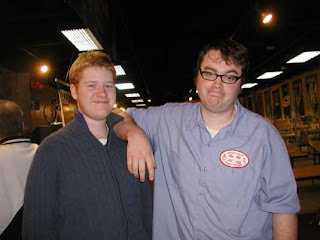
Foiled by yet another fellow Iowan...
The Aftermath
It's frustrating to lose when you've come so close, even when it's to one of the guys you work with, but the blow is softened a bit knowing Matt is headed to Malaysia. Gabe, Cheeks, and I headed back to Peter's to avoid driving home in the blizzard raging outside and stopped to pick up some groceries on the way there. The trip took about an hour instead of the 35 minutes it took us to get to the site in the morning, but pizza and Milk Duds made for a hearty meal that almost took my mind off the results of the finals.

A study in opposites.
The next morning we rose early for the 4 hour trip back to Iowa City, covering the what-ifs from throughout the event, politics, and the usual talking points on any good Magic trip. I'm happy for friends Matt Hansen and Brandon Scheel to have secured spots for themselves in Malaysia, but I definitely wanted the ticket and will be looking to get back in the saddle in Minneapolis after I return from Worlds. Minnesota is a tough place to play cards, particularly limited, so it will be a challenge at best to try to finish at one more PTQ.
Gabe Stoffa, Cheeks, Peter Martinez (L-R)
-Bill Stark
Assistant editor, TCGplayer.com
Monday, November 26, 2007
My Grand Prix: Daytona
I take one week off and everyone is running around like chickens with their heads cut off.
“Where's Riki?”
“What happened to Riki?”
Answer: I took a trip to GP Daytona Beach to judge, and what with being gone from Thursday to Monday and working 12-hour+ days at the site, it was highly unlikely that I would be able to get an article done. Now having saved some money on my auto insurance by switching to Geico, I have lots of fun stories to relate.
Getting There
Choosing to go to an out of state GP is a big deal for Magic players. It's the point when you decide that you are really “going for it,” investing both large amounts of time and money to become a better player and pursue your lofty goals.
It's roughly the same thing for a Magic judge. The decision to judge a Grand Prix within driving distance, like I did with San Francisco, is all about the decision between playing and judging. After crossing that divide, it's another Leap to get to the point where I am willing to drop a few hundred dollars on a plane ticket to Daytona Beach.
I make my decision to take the cross-country trip to Daytona Beach sometime in early October. I get in touch with the Tournament Organizer, Eric Mock, and make arrangements to judge all three days (GPT's Friday, and two days on the GP, possibly with side events mixed in), and I reserve a room in the judges' block for the Cheontourage and myself. When the dynamic duo returns from their rain-drenched trip to Valencia, we book our flights and the finality of all the planning settles into my mind.
In addition to LSV and Paul “Level 6” Cheon, I will be rooming with Grand Prix SF runner up Jon Stocks and Iain Bartolomei, who seems to have a permanent spot in California PTQ Top 8s reserved as of late. Like their predecessors in the Cheontourage, these two have vowed to push each other to the next level in 2008 with their sights firmly set on Level 3 status.
The next month passes in a Whirlwind of Magical cards between judging States, a PTQ, and the TCGpprentice. I also fit in a Guitar Hero III release party where my meager talents get blown out of the concert hall by local judge Jeff “Judge of Currents” Morrow.
On the Thursday before the event, Luis and I board our plane in Sacramento and make the short hop to LA where we have a three-hour layover until our redeye to Atlanta departs. We mull about the terminal for a bit, taking stock of our options. Luis opts for McDonalds, and like a movie theater, everything is marked up by 50%, which makes it 25% as satisfying. Look, I never said that math was my strong suit.
Unsatisfied with the Golden Arcs, we make our way to “El Cholo,” an in-terminal bar that boasts “LA's best margarita.”
Unlikely. That's the first word to cross my mind. Why is LA's best margarita being tucked away in an airport terminal bar? Sure, there's plenty of traffic in an airport, but most of these people don't care about the difference between a margarita and a Marton Stromgald as long as one of them gets them drunk for their flight.
El Cholo might have LA's best margarita, but their service leaves a lot to be desired. Luis asks for water no less than three times before our Russian-accented waiter remembers to bring them to us. The margaritas are good; I just don't know if they are “LA's best” good. They certainly aren't “twelve dollar” good.
Our flight to Atlanta is just under four hours. The in-flight movie is “Mr. Bean's”—Zzzzz. It's just before midnight so I just end up sleeping through the entire flight and miss Mr. Bean's idiotic hijinks completely.
Atlanta looks just like LAX, which looks just like Denver from the time I flew to GP Dallas. When we get to our connecting gate to Daytona Beach, we see a bunch of prone bodies on the seats. It's around 9am local time, 6am for our native Pacific time, and I imagine a lot of these people are in the same boat as us, road-worn and weary.
Iain should be in Atlanta at this point—he caught a flight out of San Francisco—so Luis calls him up. Suddenly one of the prone bodies in an adjacent row sits up and answers his phone. Like some modern day Kerouac, or maybe just a bum, Iain is on the road sleeping it up at an airport. Luis and Iain dig some packs out of their travel bags and do a Time Spiral-Planar Chaos-Planar Chaos Winston Draft. Such fiends for the game they are. They barely finish before we board our plane.
Standing outside the Daytona Beach airport, Luis and I hit the phones. He calls Jon Stocks, who has flown into Orlando and rented a car. He's about twenty to thirty minutes away from picking us up. I call Eric Mock and get the hotel information that I somehow managed to not print out.
Finally, we're here, and the room isn't ready yet. Wonderful. Some of Luis and Iain's MTGO draft buddies are hanging out in the lobby. So I meet “Aceman,” “Nova Sandler,” and a few others, never learning their real names. I think this is the new state of the world at large and Magic as a subculture where your username is your identity.
A grumpy old man (affiliated with the site, not the event staff) won't let us into the tournament venue, so our merry little band high steps it to the neighboring arcade, where among other things I get to watch some fairly good DDRing from the crew.
Trial and Error
After assorted arcade fun, it's time for me to judge the GP Trials. My head judge is Jared Sylva. He randomly divides us into teams of two to run each 32-person Sealed flight. I'm teamed up with Deb Rivkin for flight two (Yellow flight for those who saw our lovely color coordinated pairing sheets).
When the third flight kick-starts next to mine, I am taken aback to see Shuuhei Nakamura dashing to his seat. You may need a moment to let that one sink in because I certainly did. Shuuhei is one of a select few Level 6 mages in the Pro Player Club. In fact, he is the only mage to repeat as a Level 6 in the first two years of the PPC. Maybe, having finished Day One in 72nd place at GP Kitakyuushuu, Shuuhei wants a little extra practice with the format. The truth is close, but oh so much more Japanese. During rounds, I catch up with snappy-dressing pro and ask him what the heck he is doing in a GPT.
“At GP Kitakyuushuu, Shouta Yasooka asked me to play in a trial with him for fun, but I begged out, saying I was ‘tired.' Then in the main event I opened a really bad card pool.”
That's about the gist of what he tells me. The words he actually uses to describe his card pool are “kuso pack,” with kuso literally translating as sh-t. It's just another case of Japanese superstition; Japan is a nation obsessed with horoscopes, blood type personality matches for couples, and all things Miss Cleo, except they don't have the actual Miss Cleo.
For Shuuhei, the karmic translation is clear: don't play in a GPT, scrub out of main event; play in a GPT, do well? With the power of hindsight, we can see that Shuuhei barely squeaked into Day Two in 63rd place. Perhaps this means we'll be seeing Shuuhei in more GPT's in the future, trying to buy some good Karma, or perhaps barely squeaking isn't quite good enough so he'll be wearing Olivier Ruel's lucky hat.
If you're going to play in GPT's, you need to be aware of the big change that took place within the past year. Instead of being one monstrous Swiss affair that takes its winners into the dawn light hours of the morning, they run as single elimination flights of 32. The key is the single elimination part. This leads to two unique considerations.
Slow play matters (more)- Slow play should always matter and you should be vigilant in making sure your opponent does not take too long think about his plays no matter how complicated the board situation. Just like everyone else, I have an “I just needed one more extra turn to win (or force a draw)” story that means I should have played faster or prompted my opponent to do the same at some point. When you're playing in a Swiss tournament, you can afford to absorb a draw, or even a loss, due to sloppy clock management. Not saying that it is ideal, but X-1-1 will still get you into most Top 8s and Day Two cuts. Not so in a single elimination tournament where a loss boots you and a draw… well, those have their own funny rules.
The life total rule- There are no draws in single elimination; someone has to win, and if the game score is tied, the player with the higher life total in the current game wins the game and the match. If the life totals are tied, then the first change in life total determines the outcome. This can mean damaging your opponent, but also applies to life gain. I heard of one incident when a Tanglebloom won such a match for someone.
I come across one match that finishes game two during the five extra turns, leaving the match at 1-1. Both players look up at me and ask “What now?” What happens now, I explain to them, is that game three starts with the Sudden Death rule in effect. Both players' eyes open wide at this. For the next three minutes they sideboard feverishly, trying to jam as many one-drops as possible into their decks without mucking up their mana too much. I watch with interest as the player on the play keeps his hand with a smile—he's got a one-drop for sure. His opponent, one-dropless, mulligans to six, keeps that hand, and the exciting Sudden Death game begins.
Player one quickly drops a Mountain and a Boggart Forager, about the only time that card could ever be considered useful. Player two has mulliganed into a Mountain and…
#####CARDOD=15667#####
Yep. Good game. I mean, as long as he doesn't do something stupid like Tarfire the Forager (which he doesn't). Later, in another flight, I hear the roar of a crowd that probably means a similar thrilling Sudden Death victory. Other than that, the Trials proceed smoothly and we get out of there at midnight. (Although I think the final flight does not finish and all remaining players are awarded three byes, so the tech appears to be to sign up for the final flight, folks.)
Main Event: Day One
I am on side events for Day One, which means I don't need to be onsite until 11am. Unfortunately, I am rooming with four players so the hustle and bustle gets me up and I figure I'll just wander down and catch the sights. I get a chance to sit down with Ben Bleiweiss and Pete Hoefling at the Starcitygames booth. For me personally, the most interesting thing to come out of this is Ben's explanation of how his “Building on a Budget” column has evolved into what it is today based on forum responses. Even writers for Le Mothership have something to learn from the masses.
I also manage a quick exchange with Brian David-Marshall on event coverage. We swap the usual pleasantries about how much we like each other's work, but he adds a nice little “But there was that one time you misspelled my name S-H-I-L-L.”
Awkward.
Yes, there was that one time I called him out for irresponsible journalism regarding the winner of the Great Designer Search. I've heard about BDM's remarkable memory, so I figure he'll remember that. I do some quick talking about it not being personal (I did call out the entirety of WotC for that incident) and how opinions on the Internet are exaggerated for drama and conflict. I mean if you hold me sacrosanct to everything I write, I probably hate the world and the horse it rode in on. I just play a bitter doctor on TV, kids.
Anyway, with things being as busy as they are, I only have a minute or two to chat with BDM, but I think we square things away and have a good hearty handshake on it. Whatever criticism I might heap upon him—he looks awkward as hell on video coverage what with the long pauses and looking down at his notes—he's still one of the best in the business when it comes to written coverage, and I hope I have a chance to work with him in the future on that.
All of this chatting with people takes me to eleven o'clock, and since no side events are firing yet, I get the temporary shift to assist on the main event where judges are busy counting deck lists for legality. I come across one problem list with only 39 cards listed. I throw it into a pile of about a dozen lists. I guess that isn't so bad for a 650-person tournament, but it still irks me. Having never committed a deck registration error I don't understand what is so hard about counting to forty or sixty (and fifteen).
After getting the counts, it's time to match the deck lists with the players entered into the tournament to make sure we got everyone's list. I read off names from deck lists while Jeff Zandi, an occasional contributor to our site, checks them off the master list. This is actually a somewhat arduous task because Magic players have awful handwriting. On more than one occasion we have to make an educated guess and hope it's right. Shouta Yasooka is the worst offender. At the end of this task, we come up two deck lists short; apparently two players entered the tournament but didn't bother to build a deck. Took their foil Thoughtseize and went home perhaps?
I spend the next few rounds walking the floor of the main event. The bulk of a judge's time at any tournament is spent floor judging, walking around, waiting for a call, stopping to watch matches involving friends—I mean, matches that attract your interest for no particular reason. Most of the confusion on the day stems from layers, with a large number of questions starting with “I play Wings of Velis Vels….” Shapesharer and Turtleshell Changeling are two other contenders for “most asked about card.” I probably need to write a rules heavy article in the near future on these cards.
Girls, Girls, Girls
At just about the midpoint of the day, Carlos (side events head judge) and Jeff (co-TO as far as I can tell) call me over with an unusual job for me. Apparently, a handful of women want to learn how to play Magic, and they task me with putting together a tutorial session for them.
Magic… with women! Who wouldn't jump at such an opportunity? Well, me, I guess. I'm a little too old at this point to get excited just because someone has a pair of breasts. Plus, my keen mind picks up on the fact that these women have to be significant others of Magic players. There's just no other feasible explanation for why they would be at a Grand Prix and not know how to play Magic.
Jeff is explaining to one of the girls that they have to open the tutorial to both sexes lest he get hit with some kind of discrimination charge. Of course, there aren't any guys in the house who need a tutorial in Magic, so it's me and nine women together in a side event conference room with a bunch of Lorwyn precons. If that sounds sexy, you haven't been paying attention. These are Magic players' girlfriends (and fiancйs and wives as it turns out). If fact, a few boyfriends who have scrubbed out join us to help out, which is a relief for me from a manpower perspective, although it completely saps any sexiness out of the whole affair.
The tutorial moves forward with the expected minor hitches (like forgetting to explain how instants differ from sorceries. Oops.) and one major one. Teresa (or possibly Theresa) gets a little frustrated with the game state and storms out crying. Great. Add “made a girl cry” to my list of Magical accomplishments. Real nice. Do they promote you to Level 2 judge if you've ever made a girl cry?
In all fairness to me, one of the other ladies who knows her says that Teresa has tried to learn how to play Magic before with varying degrees of frustration. The Lorwyn precons we use don't exactly help matters. Teresa up and leaves a board involving Knight of Meadowgrain (lifelink and first strike) wearing Battle Mastery (double strike) and her opponent controlling Sygg, River Guide (protection). This is not a beginner-friendly situation. Other than that it's peaches, roses, and whatever. And for the rest of the weekend I have pretty women thanking me and other judges commending me for my patience. All in a day's work.
Main Event: Day Two
I'm actually on the main event staff this time, which is cool in a lot of ways. It's my first time judging in a Professional REL environment (Day One is Competitive). I get to watch the players draft up close and personal, although judging means watching their eyes to make sure they aren't running the Big Peeks, and I get zero sense of what kind of deck anyone is drafting.
After the draft, I am on the deck check team, lead by Jason Powell. Things are a lot more laid back on Day Two since we only have 64 decks to check, and the card pools themselves are smaller (45 total for Draft as opposed to 75 for Sealed). We do beginning and mid round deck checks, and the only usual occurrence is that we randomly select Alex Lieberman two rounds in a row. He's got dinged sleeves both times, even though they are clearly brand new sleeves. The first time, I watch him push the card out of the sleeve from the bottom and see exactly how the sleeve gets the distinctive finger mark. The second time is a completely different mark, so there's no need to upgrade the penalty or investigate for non-Boggart Shenanigans.
For Round Eleven, I draw the Feature Match area assignment. Judging the Feature Match area is the most exciting, boring job you can get. What I mean is, for my Feature Match assignment, I get to watch Paulo Vitor DDR (Dance, Dance, Revolution!) versus Mark Herberholz and LSV versus Tomoharu Saito. That's four of the top ten players in the world. The boring part is that these players need nary a judge. Except that this one time, they do need a judge, or more correctly, Saito needs a judge to tell him if Burrenton Forge-Tender's ability can affect damage from Mudbutton Torchrunner even after it has been sacrificed and is safely tucked away in the graveyard. (The answer is yes.)
After the second draft, it's another fun round of deck list counting. Unfortunately, one of the lists I see in the problem pile is Luis's. He's only registered 44 cards. Luckily, if you can call it that, his deck is pretty awful anyway and he 0-3s his second pod, but it's a crappy way to end what looked like such a promising run. Meanwhile, Iain finishes in 20th place, a strong showing, but just short of the Top 16 he needs to qualify for Kuala Lumpur. And of course Paul and Jon don't even manage to Day Two, this despite Paul powering up with a Hunan fortune cookie. Maybe he still has a hangover from reaching Level 6. Must.
The Draft
Finally free of the stripes, I join Luis, Paul, Ben “2006 US Nationals Team Reunion” Lundquist, Zack “I'm not Zac Hill” Hall, and Adam “no cool nickname, but I'm just damn good at Magic” Chambers for dinner at the BBQ shack across the street from the convention center. There's another table of Magic players behind us that includes Billy Moreno and Chris McDaniel amongst others. Some of our braver souls try the “fried corn,” which ends up looking more like “burnt corn.”
After dinner, our table plus Jon Stocks and Paul's friend Big Dog from LA join up in our room to do a 4v4 draft. I draft a pile, quite possible one of the worst decks I've ever drafted.
Things start off fine with Silvergill Adept and Judge of Currents. Things dry up in a hurry. I end the first pack with three Judge of Currents and nothing to make them good. No Steambed Aquitects or Silvergill Dousers. It's just a big mess. I'm getting cut off hard, and it's pretty clear that I should be in Goblins what with the Tarfire I got passed third pick and the late Muddbutton Torchrunner making the rounds.
Then in pack two, my savior arrives: Forced Fruition. This card saves my draft in a way that no ordinary bomb like Purity or Austere Command possibly could. FF allows me to fill out my deck with some late Broken Ambitions and Faerie Trickeries, along with some very questionable creature enchantments…
#####CARDID=15707#####
During deck construction, Luis convinces me to cut the trips Judge of Currents since they don't actually do anything in my deck. In their place, we pack the deck with those Zephyr Nets I had taken as a backup plan. Paul pans the deck. Zack Hall is off in his own world. I enter battle with this:
Deck:
3 Zephyr Net
1 Forced Fruition
1 Protective Bubble
1 Lairwatch Giant
1 Turtleshell Changeling
1 Stonybrook Angler
1 Goldmeadow Harrier
1 Deeptread Merrow
1 Silvergill Adept
3 Broken Ambitions
2 Faerie Trickery
1 Avian Changeling
1 Sentinels of Glen Elendra
1 Pestermite
1 Neck Snap
1 Glimmerdust Nap
1 Tideshaper Mystic
1 Ringskipper
10 Island
7 Plains
My first opponent is Adam Chambers. His loss to Tannon Grace in the last round left him in 9th place in the main event, just over half a percentage point out of the Top 8. Primarily a Limited player, Chambers has been quiet this year due to the Constructed-heavy United States GP schedule. He's hoping that his performance at Daytona will catapult him to a successful 2008 season. He is also hoping to forget his three games against me.
In game one—Game One!—Chambers plays two—Two!—Wispmares as vanilla 1/3 flyers. While I'm relieved to see him play them out before my enchantments, I wonder how I can possibly win this match against such awful cards that are particularly suited against me.
I slowly lock up his most threatening attackers with my Nets and Naps while countering others. This leaves his Wispmares free to nibble away at my life total. With the help of Surge of Thoughtweft, Chambers nibbles me down to single digits. That's when I draw the deck's Plan B. You may be a bit confused because the deck is already a pile of Plan B, a milling deck without Drowner of Secrets. So maybe it's my plan C, Lairwatch Giant with Protective Bubble.
I think I just heard jaws around the world dropping to the floor. Plan D is to put the Bubble on Turtleshell Changeling.
Let's just stick to Plans A and B then. B works well enough as Chambers can't deal with the untouchable four turn clock. When I tell Paul that I'm winning game one, he shouts, “Did you do it with Forced Fruition?” No, Paul, I didn't. But thanks for telling Chambers and the rest of his team.
Chambers runs me over in game two with some decent cards like Lys Alana Huntmaster.
I “curve out” with Stonybrook Angler, Pestermite, and Turtleshell in game three. That may sound unimpressive, but it's about as beatdown as my deck gets. It's enough pressure to force Chambers to play out his dual Wispmares as 1/3 blockers though. Unfortunately the second one blows up my Protective Bubble that was threatening to take over the game on my Turtleshell. Yes, I just wrote that and it was not sarcastic.
With the Bubble gone, I pretty much have no way to break through his Wispmare defenses (if these games sound stupid, you should have been there), and I switch to the Net plan, throwing a few on his actual cards, Plover Knights and Nath's Elite.
My next opponent is Ben Lundquist of US Nationals fame. Rumor has it that his deck is powerful and slow, the perfect matchup for my counter and mill plan. Sure enough, I trade off some early creatures and land Forced Fruition at a comfortable twelve life. Ben plays Giant Harbinger and fetches up Hearthcage Giant. I counter the Hearthcage and Glimmerdust Nap the Harbinger after it hits me once.
Ben counts his library and determines that his next spell is his last one, so he makes it a good one: Galepowder Mage. I'm dead in three swings and Ben has three cards left in his library after drawing seven for the Mage. No problem. I have Ringskipper and Protective Bubble, which guarantees me one chump block and the win…
If not for his Giant Harbinger sitting there taking a Nap. Because of that, I am forced to Protective Bubble his Harbinger to keep Galepowder Mage from waking it up. So Galepowder pushes my Ringskipper aside and I don't find an answer to it in my next three draws. One of my three Zephyr Nets would have won me the game right there. Ben absolutely crushes me in game two with an early Smokebraider.
My third match is against Big Dog, whose real name is Micah (sp?). I'm not sure if Big Dog is his MTGO name, a nickname from something else, or possibly both. What I am sure of is that by this point he can't help but have heard about my concoction. He reveals an Ajani off an early clash, but doesn't play it into my counter wall. Instead, he holds it until I tap out for Forced Fruition. At that point, he plays Ajani and Garruk, makes his army hunormous and smashes me like a bug.
The next two games are roughly the same: I play Forced Fruition and he goes for a really big turn with his planeswalkers. Fortunately for me, things end up in my favor. In one of the games, Big Dog loses a Fistful of Force clash leaving me at two. As fun as this format is, doesn't it seem like a lot of games are ending in “and then I lost the clash and the game”? The other game ends with Big Dog unable to play Fistful of Force for the win because he doesn't have enough cards left in his library to survive the Fruition.
My 2-1 record with 15th pick.dec, along with Paul's 4-0 mauling, means I don't have to play my final match against Jon, which is all well and good for me. Milling people is hard work. We war (each team member flips over a card and highest mana cost takes those cards) the picks and Luis gets them all. He gets them all. Oh, except for the leftover foil Oaken Brawler that he graciously gives to Paul for 4-0ing the draft. What a nice guy.
Animal Planet
The next day, Jon and Iain leave for their flights sometime very early in the morning. Luis, Paul, and I sleep in late—almost too late—we barely make our checkout time. We catch lunch with my fellow judge Brendan O'Connor at a restaurant that purports to serve “gator tail.” I have to try this. I just have to. I'm left somewhat disappointed. As James Spader says in Stargate: “Tastes like chicken.”
Brendan kindly gives us a ride to the airport. We check in, catch our connecting flight to Atlanta and settle in for our respective layovers with Tiago Chan, Raphael Levy, and Gadiel Szleifer. Somehow the conversation turns to animals, and this is apparently right up Levy's alley. He starts things out with a rather innocent “How many unarmed humans would it take to kill a bear?” The group asks Levy various questions about these humans. These are average people; no warriors, bodybuilders, or Peter Petrellis. They are also afraid of the bear to whatever extent normal people are afraid of bears, which means that you have to factor that fear in. It will take a certain amount of people to build up the Mob Mentality to attack in the first place.
Most of us agree that it would take something like fifty people to kill this bear. We move onto a slightly more dangerous animal. How many people would it take to kill a shark? In the ocean, we deem the number to be infinite. There's just no way people stand a chance against a shark in water. In a swimming pool, I postulate that you might be able to stack enough dead bodies into the water to suffocate the shark.
Next Levy drops the mother of hypothetical animal questions: would you rather spend a half hour in an Olympic-sized swimming pool with a shark or half a soccer field with a bear? I wonder if this is what all Magic Hall of Famers think about in their spare time. Tiago opts for the bear and I have to agree with him. Luis offers up the contrary opinion, saying, “Unless you're bleeding, the shark might ignore you.” I guess that's true. I then suggest that the bear might ignore you too, but Levy, the Crocodile Hunter of Magic, says that bears are very territorial and will attack intruders mercilessly.
After a couple more animal related discussions, we grab a bite to eat, with we fat Americans haumphing twice as much food as the Europeans. Then we scatter to our respective planes and another exciting Magic weekend is over.
In Closing
There are so many other people I met that weekend. I came across Justin Vizaro and Mike Wawszczak from TCGplayer.com in the side events area. Apparently their Main Events didn't go so well. On the plane from Daytona to Atlanta, I sat next to GP Toronto Top 8 competitor Brad Taulbee. I expanded my judge-signed foil Rule of Law collection by five, including level 5 Sheldon Menery. I also talked to the heads of two new, exciting online Magic ventures, MtgChicago and ManaNation. I also ran into Chris Williams again, who mistook me for someone else at first, but apparently it wasn't Mike Flores. Oh, and there was also Lance Loden, most famous for Kiki-Opposition from three years ago. I played him at GP Salt Lake and I've always tried to say hello since as a fellow Opposition lover.
All this and I still missed talking about that one guy or that one thing that happened at that place. That's the nature of these events. There's just too much going on in a short amount of time. This hasn't been a tournament report in the traditional sense because I didn't play. If I have advice to offer from my experiences, it would probably be:
a) Double check your deck reg sheet.
b) Play at a reasonable pace and make sure your opponent is playing at a reasonable pace.
c) If b) isn't happening, call a judge. In fact, call a judge for anything out of the ordinary.
d) Meet people and have fun.
P.S. Yes, we will have the TCGpprentice Finals this week. Fellow Seattleites Robin Russell and Zaiem Beg square off for the title of TCGpprentice, a Feature Writer position, and a bag full of marbles. The loser gets nothing. Okay, that's not true. We've set up some nice parting gifts for everyone in the Final Four. I'm looking forward to seeing how Robin and Zaiem approach the “Year in Review” and I hope you are too.
by Riki Hayashi
Friday, November 9, 2007
TPF Walkthrough
Like most of you know, half of nationals are played with Booster Draft –an uber fun format for every occasion- this is the reason why a deep knowledge of standard is necessary but not enough. In addition, the effort you put in the limited part of nationals should be greater than the constructed part, because first one requires a lot more skills than the last one.
Remembering, my first Booster Draft was back in fourth round of 2004 Mexican nationals. That day we played Mirrodin block. I had never drafted in real life before (only netdraft), I knew more or less of what it consisted, but I had no idea about the ranking of cards, and much less about strategies and archetypes, my record –totally expected- was a disaster. In retrospective, testing would have been a crucial factor to reach a better outcome, but that wouldn’t have been enough, the other complement I needed to make a better performance was some sort of guide, like the one I present, to fill the rest of holes.
Notes and explanations
1. All the statements, affirmations, conclusions and the order of picks are in my opinion, therefore, its possible that I am wrong, and not in one, but in many points.
2. The charts presented next only include commons. The reason is simple: Its more useful to have in mind the cards that we are most likely going to open, than to have infinite picks in the head where half of them are going to be useless and where the information gets atrophied.
3. The order of the rank varies according to the strategy we are following, for example, if we have plenty of rebels, the rebel-searchers are worth more, if we are playing black, but not red, cards like Henchfiend of Ukor are not even in the list, etc. The own criteria is the main judge to do these distinctions. Keeping in mind these factors helps a lot:
-Signals: This is the most important element to take into account. It consists of assimilating what’s going on in the Draft: what colors are underrated, what combinations are we passing, and the most important: determine our colors on time. For example, if we see that after our third pick the number of good green cards we are getting is overwhelming, without a doubt we should pick green - without concerning a lot about our first three picks-, keeping in mind our cost of opportunity (the colors we are passing as second better option). Why is always thus? Because that same player that is giving you green cards in the first booster is the one that is going to feed you on the third one, therefore, to reach quality and quantity in our draft, we have to pick the colors that the guys in our sides aren’t taking. Also, in the second booster we should know what colors are we going to get, according to what we passed in the first one, for example, if for taking the green cards we passed a lot of blue, we should take another non-blue color, because we are not going to get any in the second pack, for sure. This is one of the reasons why “forcing combinations” is little effective. If we love U/W, an we take this cards for whim, even if there are better in the pack, and the guy in our right (the one that passes us cards in TS & FS) is in those colors too, our deck is going to end sub optimal, because we are not going to end with enough good cards in first and third pack, although yes in second. Basically if we force colors, we risk to build a deck with only Planar Chaos, and fillers from Time Spiral and Future Sight.
-Synergy with other cards: The second element to take into account before picking a card over other one is to check which one makes a better team with the ones we already have. For example, cards with Madness (Dark Withering) with cards that make us discard (Urborg Syphon-Mage), cards with comes into play abilities (Stingscourger) with cards that makes us return them to our hand (Tolarian Sentinel).
-Curve of mana: This is one of the modules more tough to take to practice, mainly because it requires a lot of experience and an active memory. It consist of having a deck where we take total advantage of our mana sources. Something like turn 1 Shade of Trokair suspended, turn 2 Benalish Calvary, turn 3 a Morph, turn 4 Malach of the Dawn, turn 5 Castle Raptors. How to obtain this? Either being a lucksack or when in the middle of the draft we take cards that fits better in the drops we are missing. For example, if we already have a lot of cards with cost 3, we are going to give a little of more value to cards that cost 2 to complement our curve. Its important to note that this is effective when the cards have a similar value, I would never pass a great card only because of curve purposes.
-Archetypes: Finally, we have to ask us: What are we drafting?, and the answer is going to be the game plan that we have to carry out in the draft: how are we supposed to win the games and what situations can we explode, how to overcome our weakness against other decks and focus in cards that benefits our combination. My favorite archetypes are W/U, W/R, U/R, B/R, R/G & G/U.
Ranking of cards & Picks in order of hierarchy
(Don’t forget to consult cards you don’t know in the Gatherer of Wizards)
Time Spiral
White
Temporal Isolation
Castle Raptors
Amrou Scout
Amrou Seekers
Momentary Blink
Errant Doomsayers
Fortify
Benalish Cavalry
Zealot il-Vec
Flickering Spirit
Prismatic Lens
Terramorphic Expanse
Watcher Sliver
D'Avenant Healer
Blue
Errant Ephemeron
Looter il-Kor
Fathom Seer
Spiketail Drakeling
Crookclaw Transmuter
Viscerid Deepwalker
Snapback
Coral Trickster
Slipstream Serpent
Temporal Eddy
Dream Stalker
Prismatic Lens
Tolarian Sentinel
Terramorphic Expanse
Cancel
Black
Strangling Soot
Tendrils of Corruption
Dark Withering
Assassinate
Urborg Syphon-Mage
Trespasser il-Vec
Deathspore Thallid
Corpulent Corpse
Gorgon Recluse
Prismatic Lens
Mana Skimmer
Terramorphic Expanse
Feebleness
Pit Keeper
Red
Lightning Axe
Rift Bolt
Orcish Cannonade
Grapeshot
Keldon Halberdier
Flowstone Channeler
Goblin Skycutter
Bonesplitter Sliver
Coal Stoker
Bogardan Rager
Mogg War Marshal
Empty the Warrens
Green
Durkwood Baloth
Penumbra Spider
Gemhide Sliver
Nantuko Shaman
Search for Tomorrow
Herd Gnarr
Strength in Numbers
Scarwood Treefolk
Thallid Germinator
Prismatic Lens
Greenseeker
Spinneret Sliver
Ashcoat Bear
Terramorphic Expanse
Wormwood Dryad
Planar Chaos
White
Sunlance
Shade of Trokair
Whitemane Lion
Saltfield Recluse
Sinew Sliver
Pallid Mycoderm
Poultice Sliver
Aven Riftwatcher
Blue
Shaper Parasite
Erratic Mutation
Dreamscape Artist
Primal Plasma
Synchronous Sliver
Black
Rathi Trapper
Blightspeaker
Melancholy
Cradle to Grave
Midnight Charm
Spitting Sliver
Red
Dead/Gone
Prodigal Pyromancer
Stingscourger
Brute Force
Skirk Shaman
Needlepeak Spider
Green
Giant Dustwasp
Mire Boa
Evolution Charm
Citanul Woodreaders
Utopia Vow
Uktabi Drake
Future Sight
White
Judge Unworthy
Gathan Raiders
Knight of Sursi
Blade of Sixth Pride
Lucent Lumenid
Marshalling Cry
Lymph Sliver
Lumithread Field
Blue
Infiltrator Il-Kor
Aven Augur
Forsee
Gathan Raiders
Whip Spine Drake
Leaden Fists
Venser's Diffusion
Sarcomite Myr
Blind Phantasm
Black
Ichor Slick
Gathan Raiders
Death Rattle
Deepcavern Imp
Augur of Skulls
Grave Scrabbler
Mass of Ghouls
Red
Ghostfire
Riddle of Lightning
Gathan Raiders
Fatal Attraction
Flowstone Embrace
Fomori Nomad
Henchfield of Ukor
Grinning Ignus
Embermage Augur
Green
Sprout Swarm
Sporoloth Ancient
Kavu Primarch
Nessian Courier
Llanowar Empath
Edge of Autumn
Thornwield Archer
Wrap in Vigor
Being honest, the charts per se doesn’t really add useful information, except what cards to pick in a certain color, but not what colors have the best quality nor what combinations are the best ones, this depends on the experience and judgment of the people that is drafting, that is, obviously, totally personal. As for me, after a considerable amount of drafts, I have reach to some personal conjectures (in no way absolute truths) about TPF that I will share with you.
*Gathan Raiders is colorless.- You could expect this one after the FS table, it enters in any combination and it’s a great card, potentially a trick, a madness enabler and if the game becomes longer it becomes a pretty good fatty.
*Black sucks.- Is the most weak color, specially after Future Sight. I almost never draft it unless I am the only black player in the pod (you know that for the huge amount of black cards of good quality you get passed) and only with red –a lot of removal plus slivers- or white –rebels-. Being the only black player in the table, black has a lot of potential, don’t underrate it.
*White can be either very good or plain awful.- If you draft the right cards and get an average curve, white is near to insane, but if you miss one the important must have cards or loss a drop in early turns, things will go bad for you for sure. I try white with blue most of the time, to complement flyers and evasion with creatures that stall the board on the ground. The other color that does well with white is red, instead of flyers you pick early beaters and loads of removal.
*Red is the universal color.- In the personnel, I like to commingle it with Blue and Green, but it has synergy with any other color. Never forget that is going to probably be the most drafted color in the pod, for this same reason.
*Green is the most consistent color.- It has the best creatures, the most number of playables (along with white) in Time Spiral, the best commons in Future Sight, the only pump spells and one of the best common cards in limited: Sprout Swarm.
*To play blue is to bet for Tempo.- Blue offers of a lot of good stuff like bouncers, evasion and card advantage, but removal is not one of them (there are some exceptions in Planar Chaos). That’s the reason why, if we mix it with another color that doesn’t have removal (Green or White), we have to: first; pick the little removal, then, focus on a consistent base of creatures, and finally, complement them with all sort of pump spells, tricks and tempo advantage cards.
*The best archetype is U/W.- Or at least, is my favorite one (and the one from Kenji Tsumura too). Some guys with flyers and shadow along with guys that stall the board and even Rebels is almost invincible.
These are some of the advisement I can give you for TPF Draft, don’t forget to come to channel #TPF, where I learned many of these things, hopefully you might be able to join the group and test with us. Until next time.
-Pollo
Constructed: Pushing the Limits
Ah, Limited. The sweet smell of the pack being opened, flipping to the back to see that wonderful Vesuvan Shapeshifter. Nothing beats it. Everything about limited just screams fun, skill, and kick ass bombs. But it can be about so much more than that. It can improve your constructed game just as much as your limited game just by playing it. There are four basic aspects of improvement that limited gives to constructed: card evaluation, deck design, smart combat phases/open-mindedness, and keeping pace.
Card Evaluation
Playing limited is important to build card evaluation skills. Playing a card because you know that it is good is much different than playing a card because Mike Flores says to.
Card evaluation is probably the most relevant, and thus the most important skill that can be picked up in limited formats. In draft, you have forty seconds to analyze and entire pack. You must then select the best card from it and pass on everything else, with little hope of seeing other great cards from the pack. Let's analyze a pack as an example:
Magus of the Scroll
Vampiric sliver
Skittering Monstrosity
Truth or Tale
Phyrexian Totem
Moorish Cavalry
Pit Keeper
Gaze of Justice
Aetherflame Wall
Flickering Spirit
Durkwood Baloth
Rift Bolt
Thallid Germinator
Ophidian Eye
Foriysan Interceptor
This pack is tough. I'll analyze it in a vacuum first. The first cards we can drop are:
Ophidian Eye
Foriysan Interceptor
Thallid Germinator
Flickering Spirit
Aetherflame Wall
Pit Keeper
Gaze of Justice
Moorish Cavalry
Truth or Tale
Skittering Monstrosity
Vampiric Sliver
These can all be eliminated as their overall power level is low. Now for the rest of the pack:
Rift Bolt
Durkwood Baloth
Phyrexian Totem
Magus of the Scroll
Since this is in a vacuum, We can assume a 5/5 with no evasion is inferior to reusable removal. We can also assume Reusable removal is better than one-time removal. Here we drop Baloth and Bolt. Between Totem and Scroll, I'd pick Magus because it is cheaper and is more relevant during the entire game, rather than Totem who just gets better in the later game.
So, in a vacuum: Magus of the Scroll
Now, in a regular draft:
We can go ahead and eliminate all the same cards as before, and once again be left with:
Rift Bolt
Durkwood Baloth
Magus of the Scroll
Phyrexian Totem
The first thing I notice is that we have two great cards in red, which basically eliminates it as a color. The player we are passing to will no doubt be in red no matter which of the two cards we pass, so we might as well ignore red, unless we sense some very strong signals or receive a bigger bomb later. Also, as is common knowledge in TPF draft, Black is incredibly underpowered, and is strictly a splash color, unless you draft some power removal. The right pick here, then?
Durkwood Baloth.
You see, evaluation comes down to much more than just "Is this a good card?" It also comes down to noticing signals, avoiding sending wrong signals, and not allow the guy you are passing to dominate the second pack of your draft. It even comes down to which colors are stronger in the draft format, and the pace at which the format is set at. How does this translate to constructed?
When evaluating a card, you need to recognize good cards that aren't hosed totally by a popularly used card in a popularly used deck. A good example of this is Soltari Priest. Before Planar Chaos hit, Soltari Priest was in every Boros deck, and Boros was one of the top decks in the format. Then Sulfur Elemental arrived, and it absolutely hosed Javilineers, Lions, and the ever-popular and hard-to-kill Priest. This takes more than card quality into mind, it takes into mind everything. Now people use Serra Avenger and Calciderm to make opposing Sulfur Elementals into good things rather than bad things. These seemingly "weaker" and "slower" cards have replaced one of the former staples in what was once the dominant deck in standard.
Deck Design
Another thing limited contributes to your constructed game is it aids in the deck design process. The easiest way to show this is to provide you with a draft pool, and then build a deck out of it. So here goes:
1 Aetherflame Wall
1 Battering Sliver
1 Benalish Cavalry
1 Emberwilde Augur
1 Flowstone Channeler
2 Ghost Tactician
1 Glass Asp
1 Grinning Ignus
1 Icatian Crier
2 Ivory Giant
1 Jhoira's Timebug
1 Magus of the Arena
2 Needlepeak Spider
1 Revered Dead
1 Rift Elemental
1 Shade of Trokair
2 Sidewinder Sliver
1 Sinew Sliver
1 Sliversmith
1 Subterranean Shambler
1 Vitaspore Thallid
2 Whitemane Lion
1 Chronomantic Escape
1 Dawn Charm
1 Dust Corona
1 Evangelize
2 Flowstone Embrace
1 Grapeshot
1 Imperial Mask
1 Marshaling Cry
1 Mystical Teachings
1 Patrician's Scorn
4 Riddle of Lightning
1 Shivan Meteor
1 Sulfurous Blast
1 Tolaria West
Appropriate # of basic lands.
The first thing I notice about this draft pool is its horrendous mana curve. We are going to have to run some sub-par creatures. It's also going to have to break the golden seventeen-land rule and hit eighteen because we want to hit five mana quickly. We're going to need to use all the creatures we can to support the good non creature burn we have: Grapeshot, Sulfurous Blast, and the four Riddles, which are amazing in the high-curve deck we're going to probably end up with. Evangelize is one of the bombier cards we have, so we're going to use it. That leaves us with:
18 lands
4 Riddle of lightning
1 Sulfurous Blast
1 Evangelize
1 Grapeshot
I think the Emberwilde Augur is a good choice for this, as it's burn on a stick. I also like the Giants and the Shade, as they're burnish creatures that have haste, and the Giant helps riddle if hit. Magus is a definite add because it's big, meaty, and has a good CC for riddle, plus is built-in removal. With the additions of these cards, we're up to thirty, which means we need ten more. We should use the Needlepeak Spiders, because they trade with 3/3 fliers and 4/4 ground forces, and they beat for four to inch your opponent lower and lower. Now I add the Benalish Cavalry and the two Whitemanes as tricks and beats. Flowstone Channeler allows us a smoother curve, being another three-drop. Next I'm adding Sinew Sliver and Battering Sliver. Battering acts as fat and helps out Riddle. Sinew has some synergy with Battering, is a bear, and helps smooth out the mana curve. For the final few cards, I add Grinning Ignus as sort-of acceleration, and as Grapeshot feed. To top it off, Subterranean Shambler Combos very well with Whitemanes, so we'll use it. This puts us at forty cards:
8x Plains
10x Mountain
2x Ivory Giant
1x Shade of Trokair
1x Emberwilde Augur
1x Sinew Sliver
1x Benalish Cavalry
1x Grapeshot
2x Whitemane Lion
1x Flowstone Channeler
1x Grinning Ignus
2x Needlepeak Spider
1x Subterranean Shambler
1x Sulfurous Blast
1x Evangelize
4x Riddle of Lightning
1x Magus of the Arena
1x Battering Sliver
The basic strategy of this deck, as you probably picked up before, is to beat your opponent as much as you can, and then save up to burn them out. This is made easy with four Riddle of Lightning, especially if you can hit things like Riddle off of a Riddle. It has neat synergy with Shambler and Whitemane, and they also save your dudes from Sulfurous Blast (which acts as another burn spell).
So, how can this be applied to constructed? Well, aside from the manabase which is usually much more complicated in constructed, you can see you need to still focus your deck. If you can focus a pile of random cards into a deck with a purpose, you can focus every card legal in the format into a good deck. It's about finding and selecting the gems in the pool, and using them, which is MUCH easier in constructed than in limited. Heck, this draft deck can be compared to Boros Deck Wins (albeit on a slower curve, but this is limited), with the quick aggro beats and the burn to back it up. This deck hopes to win by turn seven, which, in constructed terms, is turn four-ish.
Smart Combat Phases/Open-mindedness
Limited helps by allowing you to keep an open mind on the game (and the board) and help finding alternate ways to handle a situation.
Well, limited forces you to make decisions a lot more than constructed does. There is a lot of variety in the cards, and you take a lot more into consideration. This keeps your mind more open for when you are playing constructed. It allows you to realize there is no set way to play Magic, and limited is very good for helping one realize this. It also helps you play on the fly because really, you have no choice.
One of the most difficult things for new limited players to realize is the fact that anything is an option. Cards that you'd NEVER expect to see getting played in Constructed formats run rampant, such as Ivory Giant or Needlepeak Spider. You need to be ready for anything, no matter what color your opponent is playing or how good you think you are. I've played against red/blue decks that played a forest on one turn, and then at my end of turn they made three tokens with sprout swarm. I was definitely not prepared for that, and it cost me a game I thought I had in my hands. Make sure you thoroughly go over your sideboard for something that can help against things you don't expect. This can be translated to constructed, but not exactly. Just make sure your sideboard is prepared and can handle just about anything, rather than just one deck that gives you issues.
This also connects to another point, which is to always make sure you have a smart combat phase. This is about as simple as making smart blocks, correctly using your removal, remembering to do things on declare attackers phase, and smart attacks. Why does it connect? You don't know if your opponent is holding a Venser's Diffusion, or an Ashcoat Bears. His morph can either be Fathom Seer, a Coral Trickster, or it can even be Vesuvan Shapeshifter while you have down a Spectral Force. You need to be prepared for any of these options. So this says that, in a nutshell, limited helps a constructed player stay sharp.
Keeping Pace
Playing limited is more than being a netdecking machine. There, you get to improve abilities that constructed doesn't offer. For example, mix synergy with other cards, mana curve, archetypes; all of that in less in less than 20 minutes in Sealed Deck, and less than 40 seconds in Booster Draft, which requires A LOT of skill to understand and perfect.
Speed is an aspect of the game that relates to card evaluation, but in a different way. You need to concentrate on making the fastest deck possible, as quickly as possible, and, in the case of draft, pay attention to signals and make the correct pick in less than 40 seconds. It exercises your mind so much, that if you do it enough you'll start to view cards in a different light, and start to recognize combos and synergies about them that you otherwise wouldn't. Here's an example pack, you have 30 seconds to pick.
The situation: You're in a TPF draft with forty second picks, on Future Sight. You're in RGu, and you need more removal and evasion creatures. You're almost positive the guy on you're passing to is in red, since you got cut off from it last pack. Here's the pack:
Magus of the Future
Narcoameoba
Sword of the Meek
Spellwild Ouphe
Gift of Granite
Kavu Primarch
Unblinking Bleb
Gathan Raiders
Sarcomite Myr
Edge of Autumn
Quiet Disrepair
Death Rattle
Ghostfire
Blade of the 6th Pride
Oblivion Crown
Looking at the pack, the first reaction is to take Magus. Unfortunately for us, though, it is somewhat color intensive and blue is only a splash for us (It's not exactly spectacular in Future Sight, either). There is little left in the pack if blue is gone, so we're onto our next colors. We need evasion and removal, but alas, there is no evasion. We see Ghostfire, Primarch, and the Always spectacular Gathan Raiders. This is a fairly easy decision, since we need removal; here we take Ghostfire.
Another situation:
The situation: We're in a TPF draft (with forty second picks), where it's pack one pick one. The guy next to us is loud, obnoxious, and he says he's going to try and force red/white. We need to decide whether or not to believe him, and still evaluate and make the correct choice. Here's the pack:
Serra Avenger
Evil Eye of Urborg
Tromp the Domains
Opaline Sliver
Auratog
Trespasser il-Vec
Rift Bolt
Viashino Bladescout
Pentarch Ward
Feebleness
Drudge Reavers
Search for Tomorrow
Clockspinning
Deathspore Thallid
Aetherflame Wall
What's the right pick here?
Looking at this pack, we have two bombs. Bombs almost always dictate your first picks. We now must think: are we going to get hosed of white? Serra is better than Tromp, but do we want to risk getting absolutely hosed of its color? We need to choose here. What do we take?
I take Serra. If this guy DOES end up in white, we still have time to recuperate. It's only the beginning of the draft, we still have time. Your first pick doesn't always dictate what you get, but it can help set a path. Arguments can be said in the other way, as ShadowS does. Here's what he had to say:
If you *knew* he was gonna hose you of white, I'd take Tromp.
Is that it?
I feel that lots of things that can be applied to limited are relevant in constructed (or at least the smaller constructed formats like t2 and block); knowing a set in detail is very useful for limited. It can also help you to analyze how an opponent is playing, whether they play conservatively, or just have no more gas in hand for instance. It also helps you conclude when and if to bluff, which is definitely useful. Oh, one more thing--cards which are good in limited can often be very good in constructed, even if ruled out by most pundits (see Glare of Subdual). So in sum, limited makes you a better player and improves your deckbuilding ability.
The entire point of this article was to show something that not many people realize: you do not need to practice one format over and over to get better at it, but rather that you need to practice your skills over and over to get better. Sure, constructed requires some skills more than others, but so does limited. Limited stresses some very important skills, but can sometimes have a negative effect on your overall gameplay if you overload on it. Keep this in mind, and you should be fine.

